Electricity Bill Calculator
Accurate bill estimates for Indian states
Results are approximate. Actual bills may vary.
Your Estimated Bill
Slab-wise Consumption
Bill Breakdown
| Component | Amount |
|---|---|
| Grand Total | ₹ 0 |
Smart Insights
Personalized tips to reduce your electricity bill
6-Month Bill Forecast
Estimated bills based on seasonal patterns
How Much Is the Meter Charge for 2 kW, 3 kW and 4 kW in UP?
The UPPCL calculator below gives you an instant Uttar Pradesh electricity bill estimate using official UPERC rates for 2026 — ₹5.50 to ₹6.50 per unit, plus a ₹110/kW meter charge. The UPPCL meter charge — properly called the fixed charge — is ₹110 per kW per month in urban areas and ₹90 per kW per month in rural areas. It is billed every month regardless of how many units you use.
That means:
- 1 kW — ₹110/month urban, ₹90 rural
- 2 kW — ₹220/month urban, ₹180 rural
- 3 kW — ₹330/month urban, ₹270 rural
- 4 kW — ₹440/month urban, ₹360 rural
- 5 kW — ₹550/month urban, ₹450 rural
Your sanctioned load is printed on your UPPCL bill. Note this is the capacity your connection is approved for, not what you actually draw — so if your sanctioned load is higher than you need, you are paying for capacity you never use. Reducing it is one of the few ways to cut a bill without cutting consumption.
| Sanctioned Load | Urban (₹110/kW) | Rural (₹90/kW) |
|---|---|---|
| 1 kW | ₹110 / month | ₹90 / month |
| 2 kW | ₹220 / month | ₹180 / month |
| 3 kW | ₹330 / month | ₹270 / month |
| 4 kW | ₹440 / month | ₹360 / month |
| 5 kW | ₹550 / month | ₹450 / month |
| 6 kW | ₹660 / month | ₹540 / month |
| 8 kW | ₹880 / month | ₹720 / month |
| 10 kW | ₹1,100 / month | ₹900 / month |
What Is the Cost of 1 Unit of Electricity in UP?
For domestic (LMV-1) connections in urban Uttar Pradesh, electricity costs ₹5.50 per unit for the first 150 units, ₹6.00 per unit for the next 150, and ₹6.50 per unit above 300 units per month.
In rural areas the rates are lower: ₹3.35 per unit for the first 100 units, ₹3.85 for the next 50, ₹5.00 for the next 150, and ₹5.50 above 300 units.
| Monthly units | Urban rate | Rural rate |
|---|---|---|
| First 100 units | ₹5.50 | ₹3.35 |
| 101–150 units | ₹5.50 | ₹3.85 |
| 151–300 units | ₹6.00 | ₹5.00 |
| Above 300 units | ₹6.50 | ₹5.50 |
These are telescopic slabs — you pay each rate only on the units that fall within that band, not on your whole bill.
But the per-unit rate is not what you actually pay. On top of the energy charge you pay the fixed charge (₹110/kW), a fuel surcharge, electricity duty and meter rent. A 250-unit urban bill on a 2 kW connection works out to ₹1,792 — an effective ₹7.17 per unit, not ₹5.50.
How Much Is a 250-Unit Electricity Bill in UP?
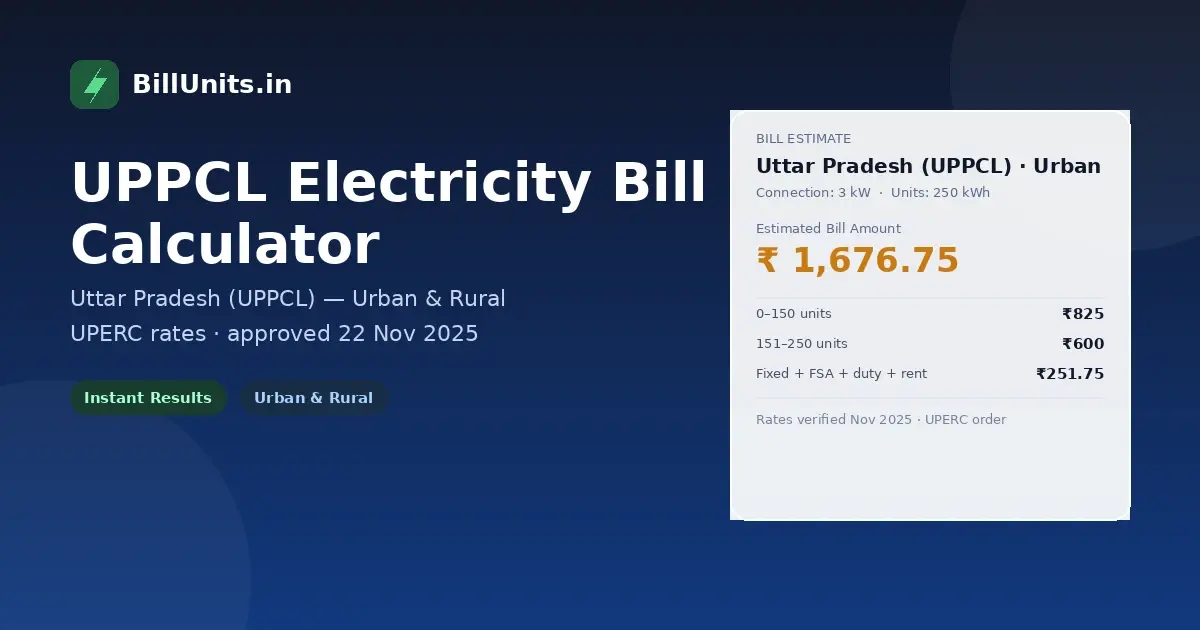
A 250-unit monthly bill on a 2 kW urban UPPCL connection comes to ₹1,792.
| Component | Calculation | Amount |
|---|---|---|
| Energy — first 150 units | 150 × ₹5.50 | ₹825.00 |
| Energy — next 100 units | 100 × ₹6.00 | ₹600.00 |
| Fixed charge | 2 kW × ₹110 | ₹220.00 |
| Fuel surcharge | 250 × ₹0.20 | ₹50.00 |
| Electricity duty | 5% of (energy + fixed) | ₹82.25 |
| Meter rent | — | ₹15.00 |
| Total | ₹1,792.25 |
Bills at other consumption levels (2 kW urban):
| Units | Urban bill | Rural bill |
|---|---|---|
| 100 | ₹843.50 | ₹575.75 |
| 150 | ₹1,142.25 | ₹787.88 |
| 200 | ₹1,467.25 | ₹1,060.38 |
| 250 | ₹1,792.25 | ₹1,332.88 |
| 300 | ₹2,117.25 | ₹1,605.38 |
| 400 | ₹2,819.75 | — |
| 500 | ₹3,522.25 | — |
What Is the Electricity Rate in Lucknow, Kanpur and Varanasi?
The same rates apply across all of urban Uttar Pradesh. UPPCL sets one tariff for the whole state through its five distribution companies — there is no separate Lucknow rate or Kanpur rate.
So whether you are in Lucknow, Kanpur, Varanasi, Agra, Meerut, Prayagraj, Ghaziabad, Noida, Bareilly or Gorakhpur, the domestic rate is ₹5.50–₹6.50 per unit with a ₹110/kW fixed charge.
The only distinction that matters is urban vs rural, not which city you live in. If your supply area is classified rural, you pay the lower rural slab rates (₹3.35–₹5.50/unit) and a ₹90/kW fixed charge.
UPPCL Electricity Bill Calculator – Uttar Pradesh
The UPPCL electricity bill calculator estimates your monthly bill using the latest UPERC-approved tariff for FY 2025-26 (approved 22 November 2025). Uttar Pradesh distributes power through five companies — PuVVNL (East), MVVNL (Central), DVVNL (South), PVVNL (West) and KESCO (Kanpur) — but they all follow the same UPERC rate schedule, so these rates apply statewide.
Domestic (LMV-1) consumers fall under one of two schedules: an Urban schedule for town and city supply, and a lower Rural schedule for village supply. Select your area type in the calculator above to get the correct estimate. Looking for other states? Visit our homepage for calculators across India.
How to Use the UPPCL Bill Calculator
1. Select Uttar Pradesh from the state dropdown (pre-selected on this page)
2. Choose your connection type — Residential (LMV-1), Commercial (LMV-2), or Other
3. Select Urban or Rural based on where your connection is located
4. Enter your sanctioned load in kW as mentioned on your connection order
5. Enter total units consumed from your latest UPPCL bill
6. Click Calculate for instant slab-wise bill breakdown with all charges
This UPPCL electricity bill calculator updates your slab-wise total instantly as you enter values above.
Live in a different state? Try our Rajasthan (JVVNL) Bill Calculator or Maharashtra (MSEDCL) Bill Calculator
How to Read Your UPPCL Electricity Meter
Reading your meter correctly is the first step to using this UPPCL electricity bill calculator accurately.
Your UPPCL electricity meter shows total units (kWh) consumed since installation. Most Uttar Pradesh homes now use digital or smart meters rolled out under the RDSS and Har Ghar Bijli schemes, displaying the current reading on a screen that cycles between reading, load, and voltage. For older meters, read the number before the decimal point.
To estimate your bill with this UPPCL electricity bill calculator, note your current reading and subtract the “previous reading” printed on your last bill to get units consumed for the month. Enter that figure above for an instant slab-wise estimate including energy charges, the 5% electricity duty, and fixed charges.
UPPCL’s four DISCOMs — DVVNL, MVVNL, PuVVNL, and PVVNL — bill domestic consumers monthly, so enter your single-month units for the most accurate result. With UP aggressively installing smart meters across Lucknow, Noida, Kanpur, and other cities, many consumers can now track real-time consumption through the UPPCL Smart Consumer app rather than reading the physical meter, helping you stay within the lower-cost slabs.
Sample Calculation: 200-Unit UPPCL Bill
Worked example for an Urban (LMV-1, Other Metered Domestic) consumer using 200 units in a month on a 2-kW connection:
- Slab 1 (0–150 units): 150 × ₹5.50 = ₹825.00
- Slab 2 (151–200 units): 50 × ₹6.00 = ₹300.00
- Energy charge subtotal: ₹1,125.00
Fixed charge (₹110/kW × 2 kW): ₹220.00 · Electricity duty (5% on energy, carried forward — see Part A note): ₹56.25 · Meter rent: ₹15.00 · Fuel surcharge (FSA): variable, assumed ₹0 here.
Estimated total: ₹1,125.00 + ₹220.00 + ₹56.25 + ₹15.00 = ₹1,416.25 (approx.). This is exactly the math the UPPCL electricity bill calculator runs behind the scenes for a 200-unit, 2 kW Urban input.
Enter 200 in the UPPCL electricity bill calculator above to see this exact breakdown, including the current FSA where applicable.
Sample Bills at a Glance
The UPPCL electricity bill calculator uses these same slabs to generate the quick-reference figures below, for a standard 2 kW Urban residential connection, energy charges only:
| Monthly Units | Slabs Applied | Energy Charge | Approx. Total (with fixed + duty + meter rent) |
| 80 units | 80 @ ₹5.50 | ₹440 | ₹700 – ₹720 |
| 150 units | 150 @ ₹5.50 | ₹825 | ₹1,105 – ₹1,125 |
| 200 units | 150 @ ₹5.50 + 50 @ ₹6.00 | ₹1,125 | ₹1,405 – ₹1,425 |
| 300 units | 150 @ ₹5.50 + 150 @ ₹6.00 | ₹1,725 | ₹2,020 – ₹2,040 |
| 400 units | 150 @ ₹5.50 + 150 @ ₹6.00 + 100 @ ₹6.50 | ₹2,375 | ₹2,690 – ₹2,710 |
Rural connections pay roughly 35–40% less per unit at every tier — use the calculator’s Rural toggle for an exact figure. These are illustrative energy-charge figures; for your exact bill use the calculator at the top of this page.
UPPCL Domestic Latest Tariff Rates — FY 2025-26
Tariff Category- Domestic Urban
| Category | Slab | Units Range | Rate |
| Urban | Slab 1 | 0 – 150 units | ₹5.50 per unit |
| Urban | Slab 2 | 151 – 300 units | ₹6.00 per unit |
| Urban | Slab 3 | Above 300 units | ₹6.50 per unit |
Tariff Category- Domestic Rural
| Category | Slab | Units Range | Rate |
| Rural | Slab 1 | 0 – 100 units | ₹3.35 per unit |
| Rural | Slab 2 | 101 – 150 units | ₹3.85 per unit |
| Rural | Slab 3 | 151 – 300 units | ₹5.00 per unit |
| Rural | Slab 4 | Above 300 units | ₹5.50 per unit |
Fixed charges: ₹110/kW (Urban), ₹90/kW (Rural). Electricity Duty: 5% on energy charges (carried forward — see accuracy note in About section). FSA: variable, revised quarterly by UPERC. Meter rent: ₹15/month (single-phase). Source: UPPCL Public Notice, UPERC order dated 22 November 2025, approving Retail Supply Tariff for FY 2025-26.
These are the exact rates the UPPCL electricity bill calculator applies to your entered units.
Understanding UP’s Urban vs Rural Domestic Tariff
Uttar Pradesh is one of the few states where your domestic rate depends on where you live, not just how much you use. The UPPCL electricity bill calculator applies the Urban LMV-1 schedule by default — ₹5.50 per unit for the first 150 units — because most metered connections fall under it. Households inside Gram Panchayat (rural) areas are billed under the lower “Other than Lifeline” schedule, starting at ₹3.35 per unit, with a reduced ₹90/kW fixed charge instead of ₹110/kW.
This urban-rural split is why two homes using identical units can receive very different bills. Before relying on any estimate, check which schedule your connection uses — it is printed on your UPPCL bill next to the LMV-1 category code. Selecting the correct variant ensures the slab rates, fixed charge, and 5% electricity duty are all applied correctly to your final amount.
What is Included in Your UPPCL Electricity Bill?
Every charge the UPPCL electricity bill calculator applies is explained in the table below.
| Charge Component | Explanation |
| Energy Charges | Slab-wise charge based on units consumed in the month. UPPCL uses a progressive slab — higher slabs attract higher rates per unit. |
| Fixed Charges | Monthly charge based on sanctioned load. Payable even in months of zero consumption. |
| Fuel Surcharge Adjustment (FSA) | Variable quarterly charge reflecting changes in fuel costs for power procurement. Approved by UPERC. |
| Electricity Duty | State tax at 5% levied on energy charges as per UP Electricity Duty Act. |
| Meter Rent | Monthly rental for the energy meter. Single-phase meters: ₹15/month. Three-phase meters: ₹40/month. |
| Regulatory Surcharge | A small charge as directed by UPERC towards regulatory asset recovery. |
| Late Payment Surcharge | 1.25%–1.5% per month if paid after the due date. |
Common Mistakes UPPCL Consumers Make
- Picking the wrong area schedule: Urban and Rural rates differ by 35–40% at every tier. Selecting the wrong one on the calculator (or assuming your bill uses the other) gives a badly wrong estimate.
- Missing the 150-unit slab jump: rates jump from ₹5.50 to ₹6.00 per unit right after 150 units Urban — a small increase in usage near that line can meaningfully raise your bill.
- Forgetting the FSA: this fuel surcharge is revised quarterly and isn’t part of the base slab rate — it’s a genuine variable add-on shown separately on your bill.
- Confusing LMV categories: LMV-1 (domestic), LMV-2 (non-domestic/commercial), and LMV-5 (tube well/irrigation) have entirely different rate structures — using the wrong category code misclassifies your connection.
- Assuming rural consumers pay Urban duty rates: duty, fixed charge, and every energy slab are lower under the Rural schedule — check which one actually applies to your connection address.
UPPCL Online Bill Payment Guide
You can pay your UPPCL electricity bill through any of these official channels:
1. UPPCL/DISCOM online payment portal — visit your DISCOM’s site (PuVVNL, MVVNL, DVVNL, PVVNL, or KESCO depending on your area) and pay via card, net banking, or UPI using your Account/Consumer ID.
2. UPPCL mobile app — log in with your registered mobile number, view your current bill, and pay directly.
3. UPPCL Smart Consumer app — for RDSS smart-meter consumers, check real-time consumption and pay bills in one place.
4. UPI apps (Google Pay, PhonePe, Paytm, BHIM) — select “Electricity”, choose UPPCL or your specific DISCOM as the biller, enter your Account ID, and pay.
5. Net banking or BBPS (Bharat Bill Payment System) through most major Indian banks.
Many consumers get a 1% rebate for timely digital payments — check your bill for the current promotion. Keep the payment receipt/reference number for any billing dispute. Once you’ve paid, re-run the UPPCL electricity bill calculator next cycle to track any tariff changes.
Tips to Reduce Your Uttar Pradesh Electricity Bill
Before the tips below, remember the UPPCL electricity bill calculator lets you test the savings from each change instantly.
1. Urban homes pay ₹5.50/unit even in the first slab, so cutting usage matters — rural (Gram Panchayat) connections enjoy a lower ₹3.35/unit entry rate. Check which schedule applies to your UPPCL connection.
2. UP government provides subsidised rates for BPL card holders — check your eligibility at your local DISCOM office.
3. Replace incandescent bulbs with LED — a 9W LED gives the same brightness as a 60W bulb, saving 85% energy.
4. Switch off geysers, coolers and ACs when not in use — standby power consumption adds up significantly.
5. Apply for rooftop solar under PM Surya Ghar Muft Bijli Yojana — UP has one of the highest solar irradiation levels in North India.
6. Get your meter tested if your bill seems abnormally high — UPPCL provides meter testing at nominal charges.
Frequently Asked Questions — UPPCL Electricity Bill
Have more questions about this UPPCL electricity bill calculator? Find quick answers below.
Q1: How is a UPPCL domestic bill calculated?
A: UPPCL uses a monthly, telescopic LMV-1 tariff with separate Urban and Rural schedules. Each slab rate applies only to the units within that band. Add the fixed charge (based on sanctioned load in kW), electricity duty, meter rent, and any fuel surcharge (FSA) to get your total
Q2: What are the current UPPCL domestic rates?
A: Urban: 0–150 units at ₹5.50/unit, 151–300 at ₹6.00/unit, above 300 at ₹6.50/unit. Rural: 0–100 at ₹3.35, 101–150 at ₹3.85, 151–300 at ₹5.00, above 300 at ₹5.50/unit — as approved by UPERC on 22 November 2025 for FY 2025-26.
Q3: What’s the difference between Urban and Rural UPPCL rates?
A: Rural consumers pay lower rates and a lower fixed charge (₹90/kW vs ₹110/kW Urban) at every consumption tier — roughly 35–40% less overall. Your area type is determined by where your connection is registered, not how much you use.
Q4: Why does my bill jump sharply after 150 units?
A: The Urban rate rises from ₹5.50 to ₹6.00 per unit above 150 units, and again to ₹6.50 above 300 units. Staying under these thresholds keeps you in the lower-cost tier.
Q5: Does UPPCL charge electricity duty on domestic bills?
A: Yes, a duty is applied on top of energy charges, commonly cited around 5%. This rate is set under the separate UP Electricity Duty Act rather than by UPERC’s tariff order, so check your latest bill for the exact current duty line.
Q6: How do I pay my UPPCL bill?
A: Pay online through your DISCOM’s portal (PuVVNL, MVVNL, DVVNL, PVVNL, or KESCO), the UPPCL mobile app, or UPI apps using your Account/Consumer ID. Many consumers get a 1% rebate for timely digital payments.
Q7: What happens if I don’t pay my UPPCL bill on time?
A: A late payment surcharge of roughly 1.25%–1.5% per month applies after the due date. Continued non-payment can lead to disconnection after the grace period specified on your bill.
Q8: Is the fuel surcharge (FSA) included in this calculator?
A: The calculator includes energy charges, fixed charges, duty, and meter rent. The FSA is variable and revised quarterly by UPERC; check your latest bill for the current per-unit FSA rate to add manually if needed.
Q9: Do commercial connections get the same UPPCL rates?
A: No. Commercial and non-domestic connections fall under LMV-2, which has a different, generally higher, fixed and energy charge structure than LMV-1 domestic.
Q10: What is a Life Line UPPCL connection?
A: Life Line consumers are households with a 1 kW contracted load using up to 100 units/month, who qualify for a reduced ₹3.00/unit energy rate and ₹50/kW fixed charge under both Urban and Rural schedules. This calculator does not yet offer a separate Life Line toggle.
Q11: Which UPPCL DISCOM serves my area?
A: Uttar Pradesh is served by five DISCOMs — PuVVNL (East), MVVNL (Central), DVVNL (South), PVVNL (West), and KESCO (Kanpur city) — all following the same UPERC-approved tariff, so this calculator applies statewide regardless of which DISCOM bills you.
Q12: How often does UPERC revise UPPCL tariff rates?
A: UPERC typically approves a new tariff order annually, usually around the start of the financial year. This page is updated whenever a new UPERC order is issued for LMV-1 domestic consumers.
UPPCL (Uttar Pradesh Power Corporation Limited) is the state-owned holding company that oversees electricity distribution across Uttar Pradesh. Formed on 30 November 1999, it supplies power through five distribution companies (DISCOMs), each covering a different region of the state. UP operates one of the largest electricity distribution networks in India.
All five DISCOMs follow the same UPERC-approved tariff. This means there is no separate rate for Lucknow, Kanpur or Varanasi — the domestic (LMV-1) rate is identical statewide. The only distinction that changes your bill is urban versus rural supply.
Tariffs are set by UPERC (Uttar Pradesh Electricity Regulatory Commission). The rates used by this calculator are verified against the official UPERC public notice dated 22 November 2025 (FY 2025-26 Retail Supply Tariff), LMV-1 Domestic.
For more on how electricity is measured and billed in India, see our Smart Meter Guide.
Lucknow, Uttar Pradesh
(FY 2025-26 Retail Supply Tariff)
| DISCOM | Main cities covered | |
|---|---|---|
| PVVNL Paschimanchal | Meerut, Ghaziabad, Noida, Saharanpur, Muzaffarnagar, Bijnor, Moradabad | 7859804803 |
| MVVNL Madhyanchal | Lucknow, Bareilly, Sitapur, Hardoi, Barabanki, Ayodhya, Shahjahanpur | 7669003409 |
| PuVVNL Purvanchal | Varanasi, Prayagraj, Gorakhpur, Azamgarh, Jaunpur, Ballia, Mirzapur | 8010968292 |
| DVVNL Dakshinanchal | Agra, Aligarh, Jhansi, Mathura, Firozabad, Etawah, Banda | 8010957826 |
| KESCO Kanpur Electricity | Kanpur city only (Kanpur Dehat is served by DVVNL) | 8287835233 |
| Figure used | Source | Status |
|---|---|---|
| Energy charge — Urban ₹5.50 / ₹6.00 / ₹6.50 per unit | UPERC Retail Supply Tariff, public notice dated 22 November 2025 (FY 2025-26), LMV-1 Domestic | ✓ VERIFIED |
| Energy charge — Rural ₹3.35 / ₹3.85 / ₹5.00 / ₹5.50 per unit | UPERC Retail Supply Tariff, 22 November 2025, LMV-1 Rural (Other than Lifeline) | ✓ VERIFIED |
| Fixed charge ₹110/kW urban · ₹90/kW rural | UPERC Retail Supply Tariff, 22 November 2025 — charged per kW of sanctioned load | ✓ VERIFIED |
| Electricity duty 5% | Not set by the UPERC tariff order. Electricity duty in Uttar Pradesh is fixed by a separate State Government notification, which we have not been able to source. | ⚠ UNCONFIRMED |
Have a recent UPPCL bill? The duty line printed on a real bill would let us confirm this figure and close the gap. We would rather tell you what we don’t know than guess.
Primary source: Uttar Pradesh Electricity Regulatory Commission (UPERC)
Neighbouring state: try our Bihar Electricity Bill Calculator (NBPDCL & SBPDCL), with the latest BERC FY 2026-27 rates and the 125 free-unit subsidy.