Electricity Bill Calculator
Accurate bill estimates for Indian states
Results are approximate. Actual bills may vary.
Your Estimated Bill
Slab-wise Consumption
Bill Breakdown
| Component | Amount |
|---|---|
| Grand Total | ₹ 0 |
Smart Insights
Personalized tips to reduce your electricity bill
6-Month Bill Forecast
Estimated bills based on seasonal patterns
BESCOM Bill Calculator — Estimate Your Karnataka Electricity Bill
If you live in Bengaluru or anywhere in the BESCOM supply area, your monthly electricity bill is made up of six separate components — and only one of them is the electricity you actually used. The rest are fixed charges, surcharges and taxes that most people never see explained.
This BESCOM bill calculator uses the official tariff approved by the Karnataka Electricity Regulatory Commission (KERC) for FY2026-27. Enter your units consumed and your sanctioned load, and it shows you exactly where every rupee goes — energy charge, fixed charge, Pension & Gratuity surcharge, electricity tax, and the newer FY25 True-up charge that started appearing on bills from May 2026.
BESCOM (Bangalore Electricity Supply Company Limited) supplies power to Bengaluru Urban, Bengaluru Rural, Ramanagara, Kolar, Chikkaballapur, Tumakuru, Davanagere and Chitradurga. The domestic tariff category is LT-1.
BESCOM Tariff Rates FY2026-27 (LT-1 Domestic)
KERC abolished the old domestic slab system. Karnataka now uses a single flat rate — every unit costs the same, whether you use 50 or 500. This makes BESCOM one of the simpler tariffs in India to calculate.
| Component | FY2025-26 | FY2026-27 (current) | FY2027-28 |
| Energy charge (per unit) | ₹5.80 | ₹5.80 | ₹5.75 |
| Fixed charge (per kW/month) | ₹145 | ₹150 | ₹160 |
| Pension & Gratuity surcharge (per unit) | 36 paise | 35 paise | 34 paise |
| Electricity tax | 9% | 9% | 9% |
| Two figures changed on 1 April 2026: the fixed charge rose from ₹145 to ₹150 per kW, and the P&G surcharge fell from 36 to 35 paise per unit. Many websites still show last year’s numbers. |
How Your BESCOM Bill Is Calculated
Your bill is built up in five steps:
- Energy charge = units consumed × ₹5.80
- Fixed charge = sanctioned load in kW × ₹150
- P&G surcharge = units consumed × ₹0.35
- Electricity tax = 9% of (energy charge + fixed charge)
- Add any FPPCA and FY25 True-up charges shown on your bill
The total is then rounded to the nearest rupee — 50 paise and above rounds up, below 50 paise is ignored.
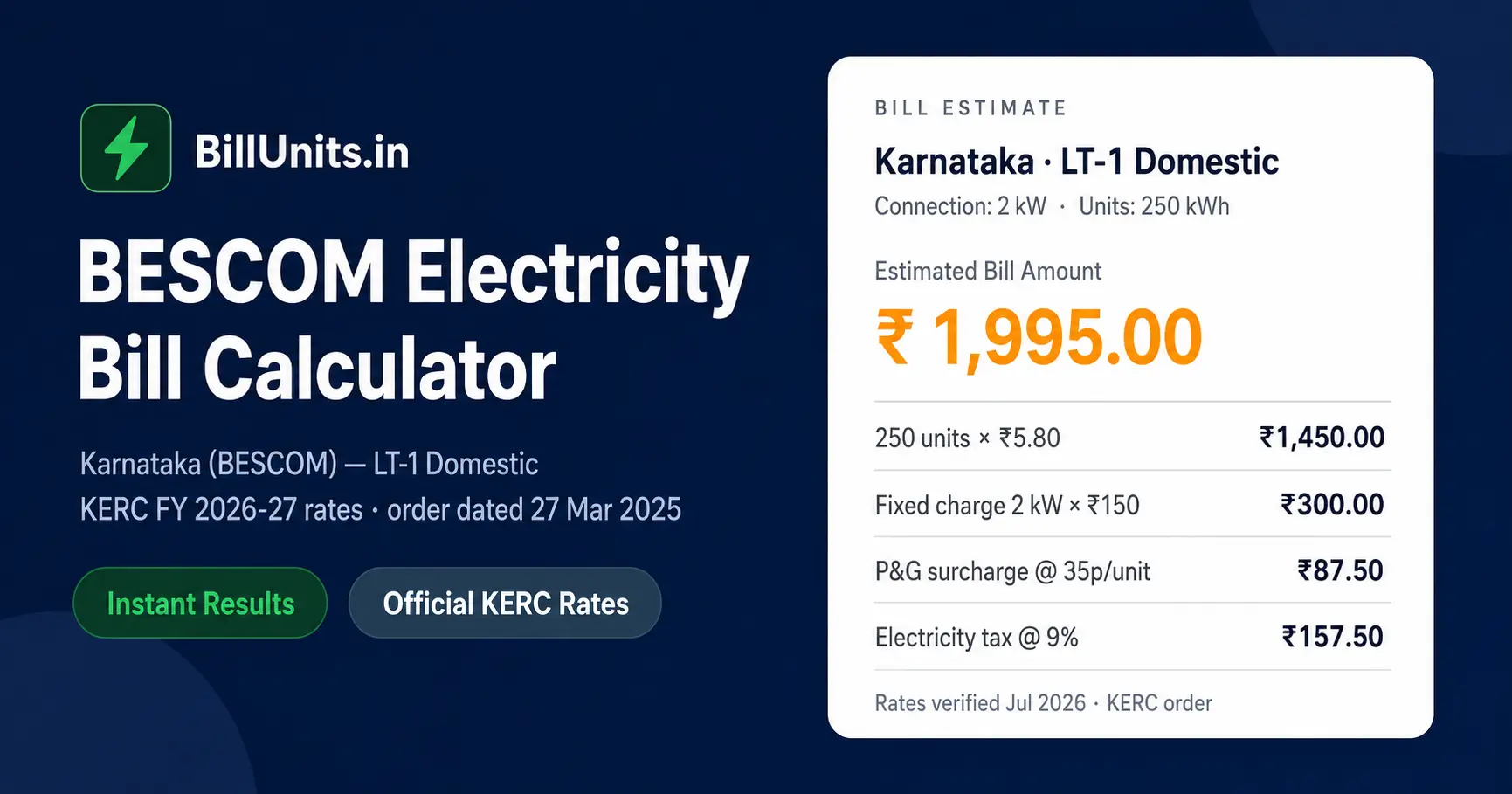
Worked Example — 250 Units, 2 kW Sanctioned Load
This is a typical Bengaluru household: a 2 BHK flat with a fridge, geyser, washing machine, TV and fans, using around 250 units a month.
| Component | Calculation | Amount |
| Energy charge | 250 units × ₹5.80 | ₹1,450.00 |
| Fixed charge | 2 kW × ₹150 | ₹300.00 |
| Pension & Gratuity surcharge | 250 units × ₹0.35 | ₹87.50 |
| Electricity tax | 9% of ₹1,750 | ₹157.50 |
| Total payable | ₹1,995.00 |
At 250 units your effective rate works out to ₹7.98 per unit — well above the headline ₹5.80, because the fixed charge, surcharge and tax add roughly 37% on top of the raw energy cost. This is why comparing states on the per-unit rate alone is misleading.
Fixed Charges — Why Your Sanctioned Load Matters
The fixed charge is ₹150 per kW of sanctioned load, every month, regardless of how much electricity you use. Even a locked, empty house pays it.
Sanctioned load is not the same as your actual usage — it is the maximum load your connection is approved for, and it is printed on your bill. A 3 kW connection pays ₹450 a month in fixed charges; a 2 kW connection pays ₹300. Over a year that difference is ₹1,800.
| Sanctioned load | Fixed charge per month | Per year |
| 1 kW | ₹150 | ₹1,800 |
| 2 kW | ₹300 | ₹3,600 |
| 3 kW | ₹450 | ₹5,400 |
| 5 kW | ₹750 | ₹9,000 |
| If your sanctioned load is higher than you actually need, you are paying for capacity you never use. Applying to BESCOM to reduce your sanctioned load is one of the few ways to cut a bill without cutting consumption. Check the load printed on your bill against what you realistically draw. |
Pension & Gratuity (P&G) Surcharge — 35 Paise per Unit
The P&G surcharge appears on every Karnataka electricity bill as “P & G Surcharge (Government Portion)”. It funds pension and gratuity obligations for employees of the erstwhile Karnataka Electricity Board, following a Karnataka High Court order and a subsequent KERC order dated 18 March 2025.
The levy came into force on 1 April 2025 and runs through FY2027-28 on a declining scale: 36 paise per unit in FY2025-26, 35 paise in FY2026-27, and 34 paise in FY2027-28. It is charged on every unit you consume.
At 250 units a month, the P&G surcharge costs you ₹87.50 — about ₹1,050 a year.
Electricity Tax — 9% on Energy and Fixed Charges
The Government of Karnataka levies electricity tax at 9% on an ad valorem basis, under Notification No. 24 dated 19 July 2018. It applies to the charges payable on electricity sold to or consumed by any consumer, excluding arrears.
This is a state government tax, not a BESCOM charge — KERC sets the tariff, but the tax rate is set separately by the state. In our worked example, 9% of (₹1,450 energy + ₹300 fixed) comes to ₹157.50.
Two categories are exempt: irrigation pump sets up to 10 HP, and Bhagyajyothi/Kutirjyothi installations.
FPPCA — The Monthly Fuel Charge That Changes Every Bill
FPPCA stands for Fuel and Power Purchase Cost Adjustment. When BESCOM’s cost of buying power moves up or down, the difference is passed to consumers as a per-unit adjustment — and it is recalculated every single month.
This is why two bills for identical consumption can differ. Recent BESCOM FPPCA rates, as approved by KERC:
| Billing month | FPPCA (paise/unit) |
| December 2025 | 31 |
| January 2026 | 39 |
| February 2026 | 24 |
| March 2026 | 44 |
| April 2026 | 47 |
| May 2026 | 25 |
Because FPPCA changes monthly, no calculator can predict it. Our calculator gives you an optional field: read the FPPCA figure off your latest bill, type it in, and the estimate becomes exact. Leave it blank and you get the base bill.
At 25 paise per unit, a 250-unit household pays an extra ₹62.50 that month.
FY25 True-Up Charges — What the New Line on Your Bill Means
From May 2026, BESCOM bills carry a new line: “FY25 True up Charges”. Most websites explain this wrongly, so it is worth getting right.
In its Annual Performance Review order dated 17 April 2026, KERC found that BESCOM had a revenue deficit of ₹2,068.38 crore for FY2024-25. Divided across the year’s approved energy sales, that works out to 56 paise per unit — and this is the number almost every website quotes.
| The 56 paise figure is NOT applied to your current usage. KERC ordered BESCOM to calculate the amount for each consumer based on their actual consumption during FY2024-25 — the year the deficit arose — and recover it in 12 equal monthly instalments from May 2026 to April 2027. So the FY25 True-up line on your bill is a fixed rupee amount driven by what you used LAST year, not this month. |
This means a household that used a lot of power in FY2024-25 but has since cut back still pays the higher instalment. It also means the charge stays the same every month for twelve months.
Because it depends on your own past consumption, no calculator can compute it for you. Our calculator provides an optional field — copy the figure from your bill and it will be included in the estimate. The charge ends with the April 2027 bill.
Consumers billed under the Discounted Energy Rate Scheme (DERS) are excluded.
Gruha Jyothi — How the Free Electricity Scheme Actually Works
Gruha Jyothi is the Karnataka government’s free electricity scheme for domestic consumers. It is widely described as “200 free units for everyone”. That is not how it works, and the misunderstanding costs people money.
| Your Gruha Jyothi entitlement is your own household’s average monthly consumption during FY2022-23, plus 10% — capped at 200 units. It is a per-household figure, not a flat 200 units. If your FY2022-23 average was 150 units, your entitlement is 165 units, not 200. |
The Government of Karnataka confirmed this in its Gruha Jyothi verification FAQ: eligible units are determined as the average consumption for FY2022-23 plus an additional 10%, and remain unchanged after verification.
The critical part is what happens when you go over. The subsidy is not partial — it is a cliff. Consume one unit above your entitlement, and the entire bill becomes payable.
| Scenario (entitlement = 165 units) | Units used | You pay |
| Within entitlement | 165 units | ₹57.75 |
| One unit over | 166 units | ₹1,434.55 |
That single extra unit costs nearly ₹1,377. If you are a Gruha Jyothi beneficiary, knowing your exact entitlement — and staying under it — is the single most valuable thing you can do for your electricity bill.
Our calculator lets you enter your entitlement (printed on your bill) and warns you clearly when your usage would push you over the cliff.
How to Use the BESCOM Bill Calculator
- Select Karnataka (BESCOM) from the state dropdown.
- Choose your connection type — Residential for a home connection.
- Enter your sanctioned load in kW. This is printed on your bill; most homes are 1–5 kW.
- Enter the units consumed for the month, from your meter reading or your bill.
- Optionally, fill the three “From Your Bill” fields — FPPCA, FY25 True-up and Gruha Jyothi entitlement — for an exact match to your bill.
- Click Calculate My Bill to see a full component-by-component breakdown.
How to Reduce Your BESCOM Bill
- Review your sanctioned load. At ₹150 per kW per month, every unnecessary kW costs ₹1,800 a year whether you use it or not.
- If you are on Gruha Jyothi, track your units mid-month. Crossing your entitlement by even one unit forfeits the entire subsidy for that month.
- Geysers and air conditioners dominate Bengaluru bills. A geyser timer and setting the AC to 24°C rather than 18°C can cut 20–25% of their consumption.
- Replace remaining incandescent and CFL bulbs with LEDs — typically 20–30 units a month across a household.
- Consider rooftop solar. BESCOM offers a rebate of ₹25 per kW on fixed charges for domestic installations up to 10 kW with an SRTPV system, and the PM Surya Ghar scheme offers central subsidy.
- Pay on time. Delayed payment attracts simple interest at 1% per month.
Sources and Verification
Every figure used by this calculator traces to an official order:
| Figure | Source |
| Energy ₹5.80/unit; Fixed ₹150/kW | KERC Tariff Order dated 27.03.2025, Tariff Schedule LT-1, FY2026-27 column |
| P&G surcharge 35 paise/unit | KERC Order dated 18.03.2025, para (h); amended 27.03.2025 |
| Electricity tax 9% | GoK Notification No. 24 dated 19.07.2018 |
| FY25 True-up (56p on FY2024-25 units) | KERC APR Order dated 17.04.2026, Table 28 |
| FPPCA monthly rates | KERC FPPCA Truing-up Order dated 29.06.2026 |
| Gruha Jyothi entitlement basis | GoK Gruha Jyothi Scheme Verification FAQ, Q11 |
| Documented gap: the 9% electricity tax is applied in this calculator to energy + fixed charges only. Whether the state also levies it on the P&G surcharge, FPPCA and true-up lines has not been confirmed against a primary source. If it does, a 250-unit bill would be approximately ₹7.88 higher. This will be updated when confirmed against an official bill. |
Last verified: July 2026. Rates change on 1 April each year — the fixed charge rises to ₹160/kW and energy falls to ₹5.75/unit on 1 April 2027, and the P&G surcharge drops to 34 paise.
94831 91222
(Android & iOS)
BESCOM (Bangalore Electricity Supply Company Limited) is a Government of Karnataka enterprise responsible for electricity distribution across eight districts of southern and central Karnataka, including Bengaluru. Its licence area covers 41,092 square kilometres and a population of over 207 lakh, making it one of India’s largest and most urbanised distribution utilities.
BESCOM was incorporated on 1 June 2002, when Karnataka unbundled the transmission and distribution businesses of KPTCL into four separate supply companies — BESCOM, MESCOM, HESCOM and GESCOM. Its tariffs, surcharges and service standards are set and regulated by the Karnataka Electricity Regulatory Commission (KERC), constituted in November 1999.
Domestic consumers are billed under the LT-1 tariff category. Karnataka is unusual among Indian states in having abolished domestic slabs entirely — every unit is charged at the same flat rate, which makes BESCOM bills simpler to verify than most.
Frequent Ask Question- BESCOM
For more on how electricity is measured and billed in India, see our Smart Meter Guide.