Electricity Bill Calculator
Accurate bill estimates for Indian states
Results are approximate. Actual bills may vary.
Your Estimated Bill
Slab-wise Consumption
Bill Breakdown
| Component | Amount |
|---|---|
| Grand Total | ₹ 0 |
Smart Insights
Personalized tips to reduce your electricity bill
6-Month Bill Forecast
Estimated bills based on seasonal patterns
JVVNL/AVVNL/JDVVNL Bill Calculator 2026- Rajasthan
Rajasthan’s electricity bill has a twist most calculators miss: your total monthly units decide which rate category you fall into, and that category re-rates your entire bill — not just the units above a slab. This Rajasthan electricity bill calculator applies the exact RERC-approved 2025 tariff for all three discoms — JVVNL, AVVNL and JDVVNL — including the category system, the monthly regulatory surcharge (FPPAS), the special FSA and the rural rebate, so your estimate matches your real bill.
Choose your discom, pick Urban or Rural supply, enter your sanctioned load and units, and get an instant, accurate breakdown. Below the tool you’ll find the full 2025 tariff structure, worked examples, sample bills and answers to common questions.
What Is the Rajasthan Electricity Bill Calculator?
The Rajasthan Electricity Bill Calculator is a free online tool that estimates your monthly domestic electricity bill under the tariff approved by the Rajasthan Electricity Regulatory Commission (RERC). Rajasthan is served by three distribution companies — JVVNL (Jaipur Vidyut Vitran Nigam) for Jaipur and eastern districts, AVVNL (Ajmer Vidyut Vitran Nigam) for central and southern districts, and JDVVNL (Jodhpur Vidyut Vitran Nigam) for western Rajasthan. All three bill under the same unified RERC tariff, so your rates are identical regardless of which discom serves you.
Instead of decoding a paper bill, you enter your discom, supply type (Urban or Rural), sanctioned load and units consumed. The calculator then reproduces the full stack RERC prescribes: category-based energy charges, a category-based fixed charge, the regulatory surcharge and special FSA, the rural rebate where applicable, and electricity duty.
How the Rajasthan Electricity Tariff Works in 2026
Rajasthan’s domestic tariff uses consumption categories, not a single telescopic ladder. Your total monthly units place you in one of four General Domestic categories, and that category fixes both your energy-rate ladder and your fixed charge. Within your category, units are still priced slab by slab. Here is the energy structure (paise converted to rupees per unit):
| Category (total monthly units) | 0–50 | 51–150 | 151–500 | Above 500 |
| GD-1 (up to 150) | ₹4.75 | ₹6.00 | — | — |
| GD-2 (up to 300) | ₹4.75 | ₹6.00 | ₹7.00 | — |
| GD-3 (up to 500) | ₹4.75 | ₹6.00 | ₹7.00 | — |
| GD-4 (above 500) | ₹4.75 | ₹6.00 | ₹7.00 | ₹7.50 |
Fixed Charges by Category
The fixed charge is a flat monthly amount set by your consumption category:
| Category | Fixed Charge (per month) |
| GD-1 (up to 150 units) | ₹150 |
| GD-2 (up to 300 units) | ₹300 |
| GD-3 (up to 500 units) | ₹500 |
| GD-4 (above 500 units) | ₹800 |
Rajasthan Electricity Bill Charges Explained
A Rajasthan domestic bill is built from several components:
- Energy Charges — the cost of units consumed, priced slab-by-slab within your consumption category.
- Fixed Charges — a flat monthly charge set by your category (₹150 to ₹800), payable even at low usage.
- Regulatory Surcharge (FPPAS) — a per-unit charge combining the Fuel and Power Purchase Adjustment Surcharge: ₹0.70 per unit if you use 100 units or less, otherwise ₹1.00 per unit on all units. It is revised monthly.
- Special FSA — an additional 7.01 paise per unit on all units, levied alongside the regulatory surcharge.
- Rural Rebate — rural domestic connections receive a 10% rebate on energy charges (where more-than-block-hours supply is not provided).
- Electricity Duty — a state levy on energy charges. Rates are set by a separate Rajasthan Government notification; confirm the current rate on your bill.
Rajasthan’s Category System: Why Crossing a Threshold Costs More
The single most important thing to understand about Rajasthan’s tariff is that your total monthly consumption picks your category, and the category re-rates your whole bill. Crossing from one category into the next raises both your fixed charge and the top slab rate that applies within your usage.
- Stay in GD-1 (≤150 units): fixed charge ₹150, top rate ₹6.00.
- Move to GD-2 (151–300): fixed charge doubles to ₹300, and units above 150 are charged at ₹7.00.
- Move to GD-3 (301–500): fixed charge rises to ₹500.
- Move to GD-4 (above 500): fixed charge is ₹800, and units above 500 are charged at ₹7.50.
| Watch your category boundaries If your usage sits just above 150 or 300 units, trimming back into the lower category cuts both your fixed charge and your top slab rate. Because the fixed charge jumps in steps (₹150 → ₹300 → ₹500 → ₹800), small changes in consumption near a boundary can produce a noticeable change in your bill. |
How to Use the Rajasthan Electricity Bill Calculator
Estimating your bill takes under a minute:
- Select your discom — JVVNL, AVVNL or JDVVNL, as printed on your bill and matching your district.
- Choose Urban or Rural — rural connections get a 10% energy rebate.
- Enter your sanctioned load — in kilowatts, from your bill.
- Enter units consumed — the kWh figure from your meter or latest bill.
- Click Calculate My Bill — review the full breakdown of energy, fixed, surcharge and duty.
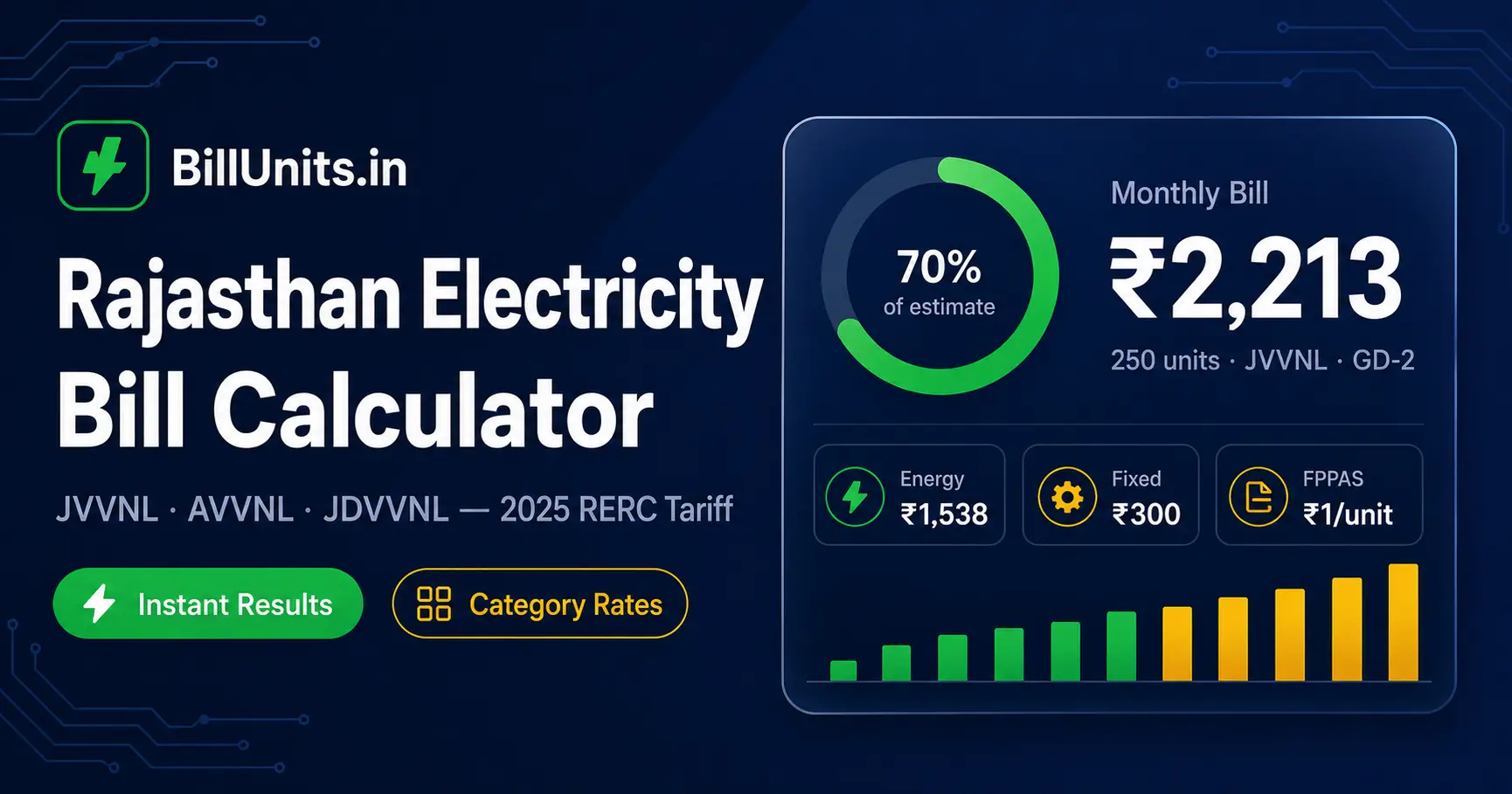
Worked Example: 250 Units on JVVNL (Urban, 3 kW)
Take a JVVNL urban household consuming 250 units (category GD-2) with a 3 kW load:
- Energy charges: 50 × ₹4.75 = ₹237.50, plus 100 × ₹6.00 = ₹600, plus 100 × ₹7.00 = ₹700 → ₹1,537.50
- Fixed charge (GD-2): ₹300.00
- Regulatory Surcharge + Special FSA: 250 × (₹1.00 + ₹0.0701) = ₹267.53
- Electricity duty (on energy): ₹107.63
Total = 1,537.50 + 300 + 267.53 + 107.63 = ₹2,212.66
A rural household with identical usage would pay ₹2,048.14 — the 10% energy rebate saving about ₹165.
Sample Rajasthan Electricity Bills (JVVNL, Urban)
Approximate JVVNL urban bills, monthly. Actual amounts vary with the monthly FPPAS. AVVNL and JDVVNL use the same rates; rural connections pay about 10% less on energy. Use the calculator above for your exact, current figure.
Estimated JVVNL urban bills across common usage levels. Notice how the fixed charge and top rate step up as you cross into a higher category.
JVVNL vs AVVNL vs JDVVNL: What’s the Difference?
All three Rajasthan discoms bill under the same unified RERC tariff — identical categories, rates, fixed charges, surcharge and duty. The only difference is geographic coverage; you cannot choose your discom.
| Discom | Area Served |
| JVVNL (Jaipur) | Jaipur, Dausa, Alwar, Bharatpur, Sikar, Jhunjhunu, Tonk and eastern districts |
| AVVNL (Ajmer) | Ajmer, Bhilwara, Udaipur, Chittorgarh, Rajsamand, Nagaur and central/southern districts |
| JDVVNL (Jodhpur) | Jodhpur, Barmer, Jaisalmer, Bikaner, Ganganagar, Pali and western districts |
Common Rajasthan Electricity Bill Mistakes
- Assuming telescopic billing — Rajasthan re-rates by category. Crossing 150 or 300 units changes your whole bill, not just the extra units.
- Forgetting the monthly FPPAS — the regulatory surcharge is revised every month, so a bill can rise without any change in usage.
- Missing the rural rebate — rural connections qualify for a 10% energy rebate; make sure your connection is classified correctly.
- Confusing sanctioned load with usage — your fixed charge follows your category, but your sanctioned load determines your connection type and limits.
- Overlooking the special FSA — the 7.01 paise per unit adds up over a full month and is easy to miss on a bill.
How to Reduce Your Rajasthan Electricity Bill
- Watch your category boundaries — if you routinely land just over 150 or 300 units, trimming back lowers both your fixed charge and your top slab rate.
- Use desert coolers over ACs where possible — evaporative coolers use far less power than air conditioners in Rajasthan’s dry heat.
- Set ACs to 24°C — every degree lower adds roughly 6% to cooling energy.
- Consider a prepaid meter — a 15 paise per unit rebate applies to prepaid connections.
- Invest in rooftop solar — Rajasthan has India’s highest solar irradiation; under the PM Surya Ghar Yojana a rooftop system can offset most of a home’s usage with strong payback.
How to Pay Your Rajasthan Electricity Bill Online
You need your 12-digit consumer account (K-number) from your bill:
- Discom portal: pay on your discom’s official website (JVVNL, AVVNL or JDVVNL) via net banking, UPI or card — no transaction charges on bills up to ₹5,000.
- Rajasthan Jan Soochna portal: the state’s public-service portal also accepts electricity bill payments.
- UPI apps: Google Pay, PhonePe and Paytm support Rajasthan discom bill payment through BBPS.
Conclusion
Rajasthan’s tariff rewards households that watch their category boundaries — 150, 300 and 500 units are the numbers that matter. Between the category-based energy and fixed charges, the monthly regulatory surcharge, the special FSA and the rural rebate, a Rajasthan bill has several moving parts, but the calculator above assembles them exactly as your discom does, for JVVNL, AVVNL or JDVVNL.
Enter your discom, supply type, load and units for an accurate estimate in seconds, then use the tariff structure and tips here to keep your bill as low as the rules allow.
Q1. Why does my Rajasthan bill jump when I cross 150 or 300 units?
Ans: Rajasthan uses a category system, not simple telescopic billing. Your total monthly units place you in a category (GD-1, GD-2, GD-3 or GD-4), and that category sets both your fixed charge and your top slab rate. Crossing 150 or 300 units moves you into a higher category, raising the fixed charge and re-rating the upper units — so the increase is more than just the cost of the extra units.
Q2. Are JVVNL, AVVNL and JDVVNL rates the same?
Ans: Yes. All three Rajasthan discoms bill under the same unified RERC-approved tariff, so energy rates, fixed charges, surcharges and duty are identical. The only difference is which geographic area each serves. You cannot switch between them.
Q3. What is the Regulatory Surcharge or FPPAS on my Rajasthan bill?
Ans: It is a per-unit charge combining the Fuel and Power Purchase Adjustment Surcharge. If you consume 100 units or less it is ₹0.70 per unit; above 100 units it is ₹1.00 per unit on all units. It is revised monthly by the discom, so it is the most common reason a bill changes without any change in usage.
Q4. What is the special FSA of 7.01 paise?
Ans: It is an additional fuel surcharge of 7.01 paise per unit, charged on all units in addition to the regulatory surcharge. On a 250-unit bill it adds a little over ₹17.
Q5. Do rural areas pay less in Rajasthan?
Ans: Yes. Rural domestic connections receive a 10% rebate on energy charges, provided more-than-block-hours supply is not being given. On identical usage, a rural household pays noticeably less than an urban one.
Q6. How is the fixed charge calculated in Rajasthan?
Ans: The fixed charge is a flat monthly amount set by your consumption category, not your load: ₹150 for GD-1 (up to 150 units), ₹300 for GD-2 (up to 300), ₹500 for GD-3 (up to 500) and ₹800 for GD-4 (above 500). You pay it every month regardless of how little you use.
Q7. Which discom serves my area?
Ans: JVVNL serves Jaipur and eastern districts, AVVNL serves Ajmer and central and southern districts, and JDVVNL serves Jodhpur and western districts. Your discom is printed at the top of your electricity bill and is fixed by where you live.
Q8. Is there electricity duty on Rajasthan bills?
Ans: Yes, electricity duty is a state levy charged on your energy charges. The tariff rates themselves are exclusive of duty, and the duty rate is set by a separate Rajasthan Government notification, so confirm the current rate shown on your own bill.
Q9. Why did my Rajasthan bill increase without extra usage?
Ans: The most common reason is a monthly revision of the regulatory surcharge (FPPAS). Other causes include crossing a category boundary at 150, 300 or 500 units, or a change in how your connection is classified.
Q10. How accurate is this Rajasthan electricity bill calculator?
Ans: It uses the current RERC-approved 2025 tariff — the correct category ladders, category-based fixed charges, the regulatory surcharge and special FSA, the rural rebate and electricity duty. It reproduces the exact stack your discom applies, so estimates match real bills closely. Because the FPPAS changes monthly, confirm the current rate against your latest bill for the tightest accuracy.
Q11. What is the K-number on my bill?
Ans: The K-number is your 12-digit consumer account number, printed on your electricity bill. You need it to pay online through your discom portal, the Rajasthan Jan Soochna portal, or UPI apps.
Q12. Can I lower my Rajasthan electricity bill?
Ans: Yes. Watch your category boundaries — trimming below 150 or 300 units lowers both your fixed charge and top rate. Use desert coolers instead of ACs where possible, set ACs to 24°C, opt for a prepaid meter for a 15 paise per unit rebate, and consider rooftop solar under the PM Surya Ghar Yojana, since Rajasthan has India’s highest solar potential.
Related State Bill Calculators
Check verified tariffs for neighbouring states.