Electricity Bill Calculator
Accurate bill estimates for Indian states
Results are approximate. Actual bills may vary.
Your Estimated Bill
Slab-wise Consumption
Bill Breakdown
| Component | Amount |
|---|---|
| Grand Total | ₹ 0 |
Smart Insights
Personalized tips to reduce your electricity bill
6-Month Bill Forecast
Estimated bills based on seasonal patterns
Delhi Electricity Bill Calculator 2026 — BRPL, BYPL & TPDDL
If your Delhi electricity bill jumps from almost nothing to over ₹2,000 the moment you cross 400 units, you are not imagining it. Delhi runs one of India’s most subsidised — and most misunderstood — domestic tariffs. This Delhi electricity bill calculator gives you an accurate, DISCOM-specific estimate in seconds for BRPL, BYPL and TPDDL, with the government subsidy, the 8% and 7% surcharges, the monthly FPPAS and the 5% electricity tax all applied exactly the way your real bill applies them.
Pick your electricity company, enter your sanctioned load and units consumed, and the calculator does the rest. Below the tool you’ll find the full 2026 tariff structure, worked examples, sample bills and answers to the questions Delhi consumers ask most.
Visit our homepage to find calculators for all Indian states.
What Is the Delhi Electricity Bill Calculator?
The Delhi Electricity Bill Calculator is a free online tool that estimates your monthly domestic electricity bill under the tariff approved by the Delhi Electricity Regulatory Commission (DERC). Delhi is served by three distribution companies — BSES Rajdhani Power Limited (BRPL) in South and West Delhi, BSES Yamuna Power Limited (BYPL) in East and Central Delhi, and Tata Power Delhi Distribution Limited (TPDDL) in North and Outer Delhi. All three follow the same DERC energy slabs and fixed charges, but each levies its own monthly Fuel and Power Purchase Adjustment Surcharge (FPPAS), which is why the calculator asks you to choose your DISCOM.
Rather than deciphering a paper bill line by line, you enter three things — your DISCOM, your sanctioned load in kilowatts and your units consumed — and the calculator reproduces the exact stack of charges DERC prescribes: energy charges, fixed charges, the 8% deficit-recovery and 7% pension surcharges, the FPPAS, the 5% electricity tax and the Delhi government subsidy. The result matches your real bill to the rupee.
How the Delhi Electricity Tariff Works in 2026
Delhi’s domestic tariff is telescopic — different slabs of units are charged at different rates, and the higher rate applies only to the units inside that slab, not to your whole consumption. On top of the energy charge sit a load-based fixed charge, two percentage surcharges, a monthly FPPAS and a 5% electricity tax. The Delhi government then applies a subsidy on the energy portion. Here is the current DERC energy-charge structure for domestic connections:
| Monthly Consumption | Energy Rate (₹/kWh) |
| 0 – 200 units | ₹3.00 |
| 201 – 400 units | ₹4.50 |
| 401 – 800 units | ₹6.50 |
| 801 – 1200 units | ₹7.00 |
| Above 1200 units | ₹8.00 |
Fixed Charges by Sanctioned Load
The fixed charge depends on your sanctioned load, not your consumption. The band your load falls into sets one per-kW rate, applied to your full sanctioned load every month:
| Sanctioned Load | Fixed Charge (per kW / month) |
| Up to 2 kW | ₹20 per kW |
| Above 2 – 5 kW | ₹50 per kW |
| Above 5 – 15 kW | ₹100 per kW |
| Above 15 – 25 kW | ₹200 per kW |
| Above 25 kW | ₹250 per kWSanctioned Load Fixed Charge (per kW / month) Up to 2 kW ₹20 per kW Above 2 – 5 kW ₹50 per kW Above 5 – 15 kW ₹100 per kW Above 15 – 25 kW ₹200 per kW Above 25 kW ₹250 per kW |
Delhi Electricity Bill Charges Explained
A Delhi domestic bill is built from several distinct components. Understanding each one shows you exactly where your money goes:
- Energy Charges — the cost of the units you actually consumed, calculated using the telescopic slabs above.
- Fixed Charges — a monthly charge based on your sanctioned load, payable even if you consume nothing.
- Surcharge — Deficit Recovery (8%) — an 8% surcharge on your basic energy plus fixed charges, approved by DERC to recover the utilities’ accumulated deficit.
- Pension Trust Surcharge (7%) — a 7% surcharge on the same base, funding the pension trust of erstwhile DVB employees. It applies to BRPL, BYPL and TPDDL alike.
- FPPAS — the Fuel and Power Purchase Adjustment Surcharge, a percentage revised every month by each DISCOM. As of July 2026 it is 17.94% for BRPL, 17.43% for BYPL and 16% for TPDDL.
- Electricity Tax (5%) — a 5% municipal tax on your energy charges, collected for the MCD.
- Subsidy — the Delhi government subsidy on your energy charges, described in the next section.
Delhi Electricity Subsidy: The 200 and 400 Unit Rules
The Delhi government subsidy is the single biggest factor in your bill — and it works as a cliff, not a sliding scale. There are three zones:
- Up to 200 units: your entire bill is waived. You pay ₹0, provided you have opted in to the subsidy.
- 201 to 400 units: you get a 50% subsidy on your energy charges, capped at ₹800 per month. You still pay the fixed charge, surcharges, FPPAS and tax.
- Above 400 units: the subsidy disappears entirely. Cross 400 units by even a single unit and you pay the full bill with no discount.
How to Use the Delhi Electricity Bill Calculator
Estimating your bill takes under a minute. Follow these steps:
- Select your DISCOM — choose BRPL, BYPL or TPDDL. It is printed on your bill and matches your area of Delhi.
- Enter your sanctioned load — in kilowatts, shown on your bill (commonly 2–5 kW for homes).
- Enter units consumed — the kWh figure from your meter or latest bill.
- Choose the billing period — monthly or bi-monthly, to match your billing cycle.
- Click Calculate My Bill — review the full breakdown: energy, fixed, surcharges, FPPAS, tax and subsidy.
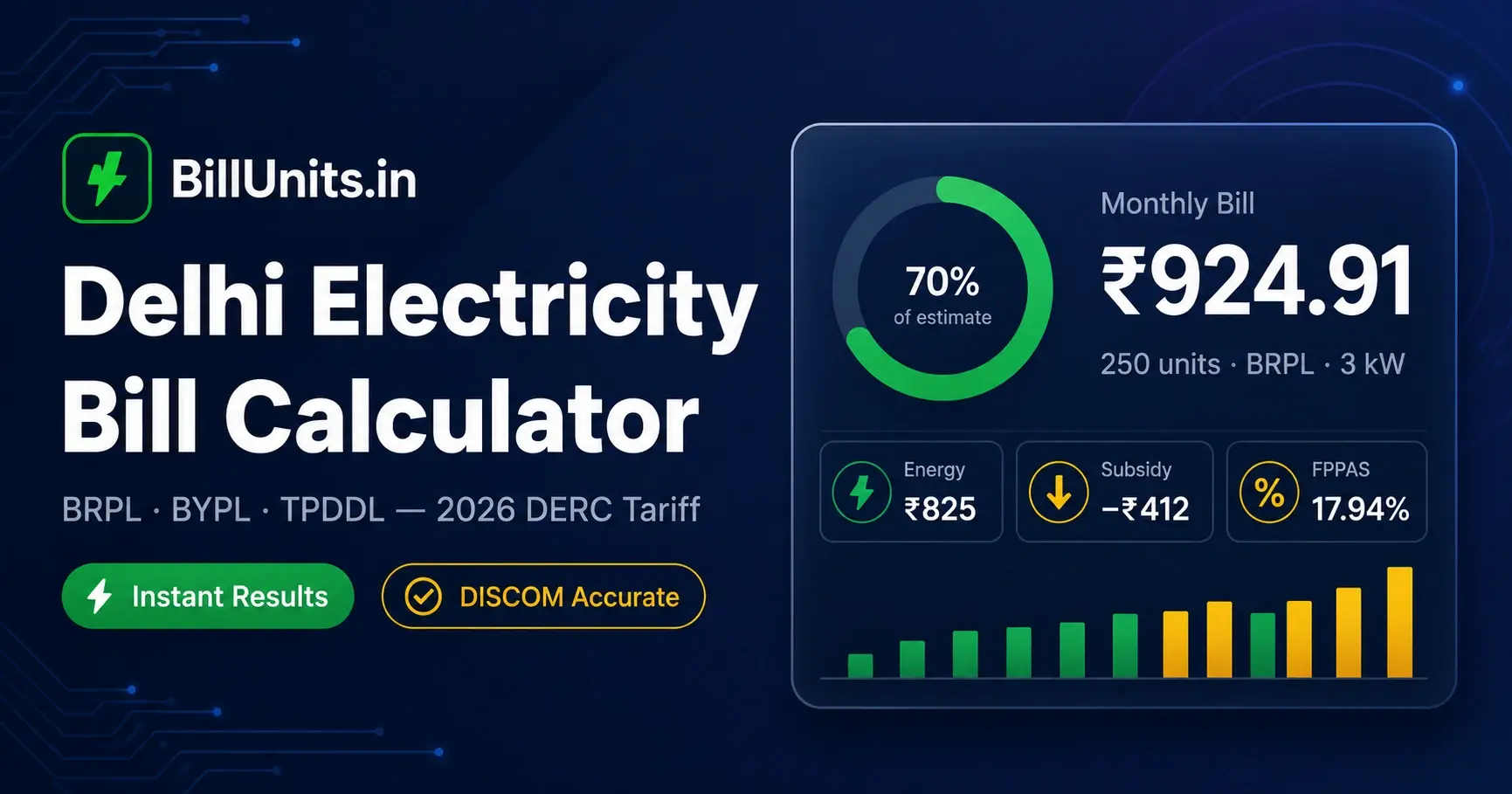
Worked Example: 250 Units on BRPL (3 kW)
Take a BRPL household in South Delhi consuming 250 units with a 3 kW sanctioned load. Here is how the bill is built:
- Energy charges: first 200 units × ₹3.00 = ₹600, next 50 units × ₹4.50 = ₹225 → ₹825.00
- Fixed charge: 3 kW × ₹50/kW (2–5 kW band) = ₹150.00
- Deficit surcharge (8%): 8% of (₹825 + ₹150) = ₹78.00
- Pension surcharge (7%): 7% of (₹825 + ₹150) = ₹68.25
- FPPAS (BRPL 17.94%): 17.94% of (₹825 + ₹150) = ₹174.91
- Electricity tax (5%): 5% of ₹825 energy = ₹41.25
- Subsidy: 50% of ₹825 energy = ₹412.50 (within the ₹800 cap)
Total = 825 + 150 + 78 + 68.25 + 174.91 + 41.25 − 412.50 = ₹924.91
That is an effective rate of about ₹3.70 per unit — the subsidy doing most of the work.
Sample Delhi Electricity Bills (BRPL)
Figures are BRPL, monthly, residential, July 2026 FPPAS. BYPL and TPDDL differ only by their FPPAS rate. Use the calculator above for your exact DISCOM and load.
BRPL vs BYPL vs TPDDL: What’s the Difference?
All three Delhi DISCOMs use identical DERC energy slabs, fixed charges, surcharges, tax and subsidy. The only figure that differs is the monthly FPPAS. Your DISCOM is fixed by where you live — you cannot choose between them.
| DISCOM | Area Served | FPPAS (Jul 2026) |
| BRPL (BSES Rajdhani) | South & West Delhi | 17.94% |
| BYPL (BSES Yamuna) | East & Central Delhi | 17.43% |
| TPDDL (Tata Power) | North & Outer Delhi | 16.00% |
Because FPPAS is revised monthly by DERC, these percentages change frequently. The calculator uses the current published rates; always confirm against your latest bill.
Common Delhi Electricity Bill Mistakes
- Ignoring the 400-unit cliff — assuming 401 units costs only slightly more than 400. It doesn’t; you lose the whole subsidy.
- Not opting in to the subsidy — the ≤200-unit free benefit and the 50% slab require an active opt-in. Without it you are billed in full.
- Confusing sanctioned load with consumption — fixed charges follow your kW load, not your units. A higher load raises your fixed charge every month.
- Overlooking FPPAS changes — a bill that rose without extra usage is usually a monthly FPPAS revision, not a metering error.
- Assuming all DISCOMs bill the same — the base tariff is identical, but the FPPAS differs, so the same usage costs a little more or less by area.
How to Reduce Your Delhi Electricity Bill
- Stay under 200 units where possible — efficient appliances and LED lighting can keep a small household fully subsidised.
- Watch the 400-unit line — if you routinely land at 410–430 units, trimming usage back under 400 restores the ₹800 subsidy.
- Right-size your sanctioned load — if your load is far above what you use, a load reduction lowers your monthly fixed charge.
- Set AC to 24°C — every degree lower can add roughly 6% to cooling energy; 24°C is the efficient sweet spot.
- Consider rooftop solar — a 3 kW system can offset most of a typical Delhi home’s usage, and the PM Surya Ghar Yojana offers a subsidy of up to ₹78,000.
How to Pay Your Delhi Electricity Bill Online
Each DISCOM offers a quick online payment portal. You need only your CA (Consumer Account) number, printed on your bill:
- BRPL & BYPL: use the BSES Quick Pay option on the official BSES portal, enter your CA number, and pay by UPI, net banking or card.
- TPDDL: use the Tata Power-DDL Quick Pay page, enter your CA number, and complete payment through your preferred method.
Payments through the official DISCOM portals are recommended over third-party apps for the most reliable posting to your account.
Conclusion
Delhi’s domestic tariff rewards households that stay aware of two numbers: 200 units for a free bill, and 400 units before the subsidy cliff. Between the DERC slabs, the load-based fixed charge, the 8% and 7% surcharges, the monthly FPPAS and the 5% tax, a Delhi bill has many moving parts — but the calculator above assembles them exactly as your DISCOM does, for BRPL, BYPL or TPDDL.
Enter your DISCOM, load and units to get an accurate estimate in seconds, then use the tariff structure and tips on this page to keep your bill as low as the rules allow.
FAQs- Delhi Electricity Bill Calculator
Q1. Is electricity really free up to 200 units in Delhi?
Ans: Yes. If your monthly consumption is 200 units or below and you have opted in to the Delhi government subsidy, your entire bill — energy charges, fixed charges, surcharges and tax — is waived, and you pay ₹0. The opt-in is a one-time process; without it, you are billed in full even under 200 units.
Q2. What happens if I cross 400 units in Delhi?
Ans: Crossing 400 units removes the government subsidy completely. Up to 400 units you receive a 50% subsidy on energy charges (capped at ₹800), but at 401 units and above you get no subsidy at all. This is why a 401-unit bill can be over ₹700 higher than a 400-unit bill — you lose the entire subsidy, not just pay for one extra unit.
Q3. Why is my Delhi electricity bill different from my neighbour’s?
Ans: If your neighbour is in a different part of Delhi, they may be on a different DISCOM. BRPL, BYPL and TPDDL use identical energy slabs and fixed charges, but each sets its own monthly FPPAS, so the same usage costs slightly different amounts by area. Differences also come from sanctioned load, subsidy opt-in status, and how close each of you is to the 200 or 400 unit thresholds.
Q4. What is FPPAS on my Delhi electricity bill?
Ans: FPPAS stands for Fuel and Power Purchase Adjustment Surcharge. It is a percentage added to your energy and fixed charges to reflect changes in the cost of fuel and power your DISCOM buys. DERC revises it every month, so it is the most common reason a bill rises without any change in your usage. As of July 2026 it is 17.94% for BRPL, 17.43% for BYPL and 16% for TPDDL.
Q5. How is the fixed charge on my Delhi bill calculated?
Ans: The fixed charge is based on your sanctioned load in kilowatts, not your consumption. The load band you fall into sets a per-kW rate — ₹20/kW up to 2 kW, ₹50/kW for 2–5 kW, ₹100/kW for 5–15 kW, and higher above that — which is then multiplied by your full sanctioned load. You pay this every month even if you use very little electricity.
Q6. What are the 8% and 7% surcharges on my bill?
Ans: These are two DERC-approved surcharges applied to your basic energy plus fixed charges. The 8% surcharge recovers the distribution companies’ accumulated deficit, and the 7% surcharge funds the pension trust of former Delhi Vidyut Board employees. Both apply to BRPL, BYPL and TPDDL consumers alike.
Q7. Which DISCOM am I on — BRPL, BYPL or TPDDL?
Ans: Your DISCOM is printed on your electricity bill and is fixed by where you live. BRPL (BSES Rajdhani) serves South and West Delhi, BYPL (BSES Yamuna) serves East and Central Delhi, and TPDDL (Tata Power) serves North and Outer Delhi. You cannot switch between them.
Q8. Do I need to apply for the Delhi electricity subsidy?
Ans: Yes. The subsidy is not automatic — you must opt in once, either through your DISCOM or the government’s designated process. Once active, the free-up-to-200-units benefit and the 50% subsidy on 201–400 units apply automatically to your bills each month.
Q9. Is there electricity tax on Delhi bills?
Ans: Yes. A 5% electricity tax is charged on your energy charges, collected on behalf of the Municipal Corporation of Delhi. It applies in addition to your energy and fixed charges and is not covered by the subsidy.
Q10. Why did my Delhi bill increase even though my usage stayed the same?
Ans: The most common cause is a monthly FPPAS revision by DERC — your DISCOM’s fuel and power-purchase surcharge went up, so your bill rose even with identical consumption. Other causes include crossing the 200 or 400 unit thresholds, a change in sanctioned load, or the subsidy opt-in lapsing.
Q11. How accurate is this Delhi electricity bill calculator?
Ans: The Delhi electricity bill calculator uses the current DERC-approved tariff — the correct energy slabs, load-based fixed charges, the 8% and 7% surcharges, each DISCOM’s FPPAS, the 5% electricity tax and the government subsidy rules. It reproduces the exact stack of charges your DISCOM applies, so estimates match real bills closely. FPPAS changes monthly, so for the tightest accuracy confirm the current rate against your latest bill.
Q12. Can I lower my Delhi electricity bill?
Ans: Yes. Staying under 200 units keeps a small household fully subsidised. If you regularly land just above 400 units, trimming back under 400 restores the ₹800 subsidy. Reducing an oversized sanctioned load cuts your monthly fixed charge, setting your AC to 24°C lowers cooling costs, and rooftop solar under the PM Surya Ghar Yojana (subsidy up to ₹78,000) can offset most of a typical home’s usage.
Enter your DISCOM, load and units to get an instant, DERC-accurate estimate — subsidy, FPPAS and tax included.
⚡ Calculate My Bill NowRelated State Bill Calculators
Living near a border or moving states? Check the latest verified tariffs for neighbouring states.
For more on how electricity is measured and billed across India, see our Smart Meter Guide.