
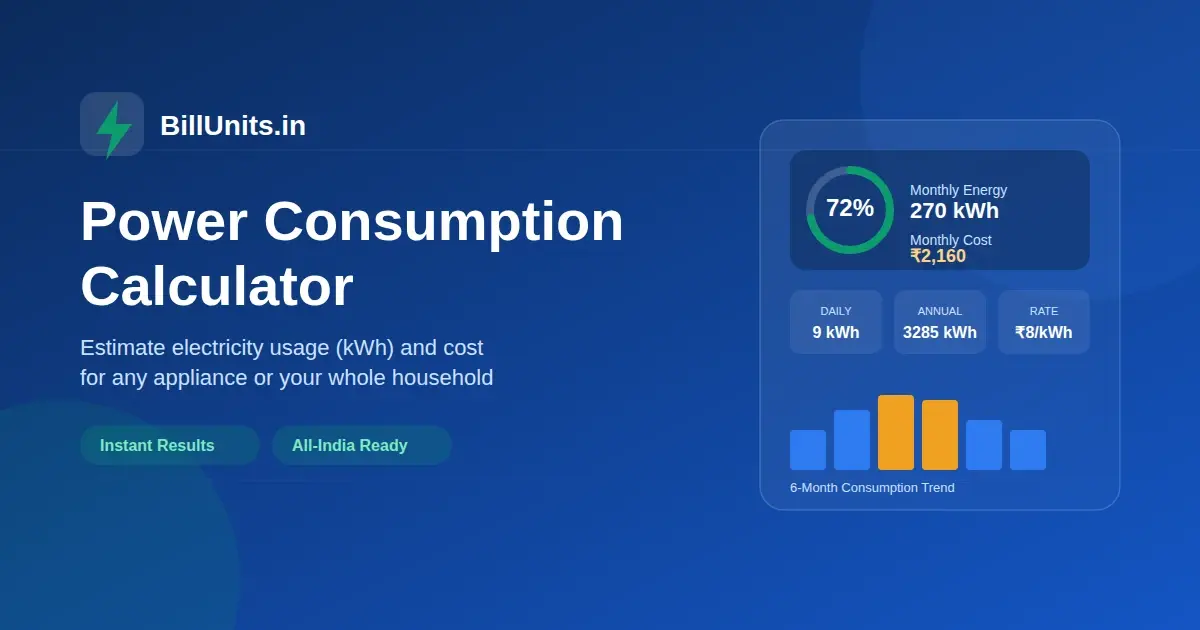
Use this free power consumption calculator to instantly estimate how much electricity your appliances use and what they cost in India. Whether you’re checking a single device or your entire household’s combined load, this tool gives you accurate daily, monthly, and annual energy and cost estimates in seconds.
Power Consumption Calculator
Estimate how many units (kWh) your appliances use and what they cost in electricity bills — for a single device or your whole household.
Add every appliance in your home or shop to estimate total household consumption.
| Appliance | Power (W) | Qty | Hrs/day | Days | Energy | Remove |
|---|
Your Results
Enter your appliance details and click Calculate to see consumption and cost estimates here.
| Metric | Current | Optimised | Saved |
|---|
Estimates only. Actual bills also include fixed charges, duty, and slab-based tariffs that vary by state and DISCOM. For your exact bill, use BillUnits’ state-specific electricity bill calculators.
A Complete Guide to Calculating Electricity Usage and Cost
Understanding how much electricity your appliances actually consume is the first step toward controlling your monthly electricity bill. Whether you’re running a single air conditioner or managing the combined load of an entire household or shop, knowing the exact power consumption in units (kWh) helps you budget accurately and identify where you can save. This guide explains everything you need to know about power consumption, how it’s calculated, and how to use it to lower your electricity costs anywhere in India.
What is Power Consumption?
Power consumption refers to the amount of electrical energy an appliance or device uses over a period of time. It is the bridge between an appliance’s power rating (how much electricity it draws at any instant, measured in watts) and your electricity bill (which is based on total energy used over days or months, measured in kilowatt-hours).
Every appliance you own — from a 9-watt LED bulb to a 2000-watt geyser — has a power rating printed on its body or in its manual. But the rating alone doesn’t tell you what it costs to run. Cost depends on three things working together: how powerful the appliance is, how long you run it, and how many days you use it for. This is exactly what a power consumption calculator works out for you instantly.
How Power Consumption is Calculated
The calculation behind every electricity bill, no matter how complex the final tariff structure, starts with one simple formula.
The Formula
Energy (kWh) = (Power in Watts × Quantity × Hours Used per Day × Number of Days) ÷ 1000
If your appliance’s power rating is already in kilowatts, you skip the division:
Energy (kWh) = Power in kW × Quantity × Hours Used per Day × Number of Days
Once you know the energy consumed, the cost is straightforward:
Cost (₹) = Energy Consumed (kWh) × Electricity Rate (₹ per kWh)
Worked Example
Let’s calculate the power consumption of a 1.5-ton air conditioner rated at 1500 watts, used for 6 hours a day, for 30 days, with an electricity rate of ₹8 per unit.
| Step | Calculation | Result |
| Daily energy | (1500 × 1 × 6) ÷ 1000 | 9 kWh/day |
| Monthly energy | 9 × 30 | 270 kWh/month |
| Monthly cost | 270 × ₹8 | ₹2,160 |
| Annual energy | 9 × 365 | 3,285 kWh/year |
| Annual cost | 3,285 × ₹8 | ₹26,280 |
This is precisely the type of calculation our Power Consumption Calculator above performs instantly, along with cost breakdowns, charts, and personalised energy-saving tips.
Units Explained: Watts vs Kilowatts
Confusing watts and kilowatts is one of the most common mistakes people make when estimating electricity usage.
| Unit | Symbol | Equivalent | Typical Appliances |
| Watt | W | Base unit of power | LED bulbs, fans, chargers, routers |
| Kilowatt | kW | 1,000 watts | Air conditioners, geysers, induction cooktops, motors |
| Kilowatt-hour | kWh | Energy used by 1 kW load for 1 hour | The “unit” shown on your electricity bill |
A simple way to remember it: watts measure power (instant draw), while kilowatt-hours measure energy (total usage over time). Your electricity meter tracks kWh, not watts — which is why hours of usage matter just as much as an appliance’s wattage.
kWh Explained: What is a “Unit” of electricity?
In India, electricity bills are always expressed in units, and one unit is exactly equal to one kilowatt-hour (kWh). One kWh is the amount of energy consumed when a 1000-watt device runs continuously for one hour. So:
- A 1000W appliance running for 1 hour = 1 unit
- A 500W appliance running for 2 hours = 1 unit
- A 100W appliance running for 10 hours = 1 unit
This is why two completely different appliances — one powerful but used briefly, another weak but left running all day — can consume the same number of units.
How Electricity Bill is Calculated in India
While the energy formula above gives you the base cost of running an appliance, your actual electricity bill from your state DISCOM typically includes additional components:
- Energy charges: Based on total units consumed, often in increasing telescopic slabs (the more you use, the higher the per-unit rate in higher slabs)
- Fixed/demand charges: A flat charge based on your sanctioned load or connection type, regardless of usage
- Electricity duty: A state government levy calculated as a percentage of the energy charge
- Subsidies or rebates: Some states offer subsidised rates for low consumption or specific consumer categories
- Meter rent and other minor charges: Small fixed charges added by some DISCOMs
- For official tariff orders and regulatory details specific to your state, you can refer to your state electricity regulatory commission’s website or the Central Electricity Authority.
This is why a power consumption calculator gives you an accurate energy and base-cost estimate, but your printed bill amount can differ once slabs, duty, and fixed charges are layered on. For an exact bill estimate matching your specific state’s tariff structure, BillUnits provides dedicated state-wise electricity bill calculators covering all DISCOMs across India.
Ways to Reduce Electricity Usage
Small, consistent changes — tracked with a power consumption calculator — in how you use appliances can add up to meaningful savings over a year. Here are the most effective, practical ways to cut electricity consumption in Indian homes and shops:
- Switch to LED lighting — LED bulbs use up to 80-90% less energy than incandescent bulbs or older tube lights for the same brightness.
- Use BLDC fans — Brushless DC ceiling fans consume roughly 30-35W compared to 75W for conventional fans, cutting fan electricity use by more than half.
- Set air conditioners to 24-26°C — Every degree below this range can increase AC energy consumption by approximately 6%.
- Clean AC and cooler filters regularly — A clogged filter forces the compressor to work harder, increasing consumption by 10-15%.
- Use inverter-technology appliances — Inverter ACs, refrigerators, and washing machines adjust power draw to actual need instead of constantly cycling at full load.
- Unplug idle electronics — Chargers, set-top boxes, and inverters draw small amounts of standby power around the clock; switching them off at the plug avoids this phantom load.
- Run full loads — Washing machines and dishwashers are most efficient when run with full loads rather than multiple half-loads.
- Use natural light and ventilation — Reducing reliance on artificial lighting and cooling during the day directly lowers daily kWh consumption.
- Service your refrigerator’s door seals — Worn seals let cool air escape, forcing the compressor to run longer than necessary.
- Shift usage to off-peak hours where applicable — Some states offer time-of-day tariffs with lower rates during off-peak hours.
Most Power-Hungry Appliances in an Indian Home
Running these numbers through a power consumption calculator shows some appliances consume significantly more electricity than others, either because of high wattage or because they run for long hours. Here’s a typical breakdown:
| Appliance | Typical Power Rating | Usage Pattern | Relative Impact |
| Air Conditioner (1.5 Ton) | 1,200–1,800 W | 4-10 hrs/day in season | Very High |
| Geyser / Water Heater | 1,500–2,000 W | 0.5-1.5 hrs/day | High |
| Induction Cooktop | 1,800–2,200 W | 1-2 hrs/day | High |
| Room Heater | 1,500–2,000 W | 2-4 hrs/day in winter | High |
| Washing Machine | 400–600 W | 0.5-1 hr/day | Moderate |
| Refrigerator | 100–200 W | 24 hrs/day | Moderate (due to runtime) |
| Microwave Oven | 1,000–1,400 W | 0.2-0.5 hrs/day | Low-Moderate |
| Ceiling Fan | 50–80 W | 8-16 hrs/day | Low-Moderate (due to runtime) |
| LED Television | 80–150 W | 3-6 hrs/day | Low |
| LED Bulb | 7–15 W | 4-8 hrs/day | Very Low |
Notice that runtime matters as much as wattage — a refrigerator’s modest 150W rating adds up because it runs all day, every day, while a microwave’s high wattage has limited impact because it’s used briefly.
Monthly Consumption Examples
Here are realistic monthly consumption estimates a power consumption calculator would produce for common appliances used at typical Indian household usage patterns, calculated using the standard formula:
| Appliance | Power | Daily Hours | Monthly Units (kWh) | Cost at ₹8/unit |
| Air Conditioner (1.5 Ton) | 1,500 W | 6 hrs | 270 kWh | ₹2,160 |
| Refrigerator | 150 W | 24 hrs | 108 kWh | ₹864 |
| Geyser | 2,000 W | 1 hr | 60 kWh | ₹480 |
| Washing Machine | 500 W | 1 hr | 15 kWh | ₹120 |
| Ceiling Fan (×3) | 75 W each | 8 hrs | 54 kWh | ₹432 |
| LED Television | 120 W | 4 hrs | 14.4 kWh | ₹115 |
| LED Bulbs (×5) | 9 W each | 5 hrs | 6.75 kWh | ₹54 |
Adding these together gives you a realistic sense of how a typical urban household’s monthly bill is distributed across appliances — which is exactly what the Multiple Appliances mode in the calculator above helps you visualise for your own home.
Power Consumption Calculation for Shops and Small Businesses
Shop owners, small offices, and commercial establishments can use a power consumption calculator to handle a mix of appliances running simultaneously for long operating hours, which makes manual bill estimation harder than for a typical household. The same core formula applies, but a few extra considerations matter for commercial use:
- Combine all running appliances: Lighting, fans, air conditioners, refrigeration units, computers, and equipment like printers or POS machines should all be added using the Multiple Appliances mode to get a true total load.
- Account for operating hours, not just shop hours: Refrigeration units, security cameras, and routers often run 24 hours a day even when the shop is closed, while lighting and ACs may only run during business hours.
- Use your actual commercial tariff rate: Commercial electricity rates are usually higher than domestic rates and may not have the same slab structure, so always use your specific commercial per-unit rate rather than a domestic default.
- Factor in equipment efficiency: Older or poorly maintained equipment, especially compressors and motors, often draws more power than their rated value due to reduced efficiency — the calculator’s Advanced Options let you adjust for this using the Efficiency (%) field.
- Plan for seasonal variation: Cooling load (and therefore electricity cost) for shops can vary significantly between summer and winter months, so it’s useful to calculate consumption separately for peak season and off-season.
For example, a small retail shop running two 1.5-ton air conditioners (3,000W combined) for 8 hours a day, four ceiling fans (300W combined) for 10 hours, and lighting (200W) for 12 hours, at a commercial rate of ₹9/unit, would consume roughly 29.4 kWh per day — translating to about ₹7,938 per month just from these three categories, before adding refrigeration, computers, or other equipment. Running this kind of multi-appliance estimate before the billing cycle ends helps business owners budget accurately and spot unusually high-consumption equipment early.
Understanding Efficiency, Load, and Power Factor Adjustments
The basic formula assumes an appliance always draws exactly its rated power for the full duration it’s switched on. In reality, several factors can make actual consumption higher or lower than this simple estimate, which is why the calculator above includes an Advanced Options section:
- Efficiency (%): No appliance converts 100% of the electricity it draws into useful output — some is lost as heat or mechanical loss. Older or poorly maintained motors, compressors, and heating elements often operate below their rated efficiency, meaning they draw closer to their full rated wattage for longer to deliver the same result. If you know an appliance is operating below peak efficiency, lowering this value gives a more realistic estimate of effective power draw.
- Operating Load (%): Many appliances, especially motors, pumps, and inverter-based ACs, don’t run constantly at 100% of their rated capacity. An inverter AC, for instance, draws full power only briefly during cooldown and then cycles to a lower load to maintain temperature. Setting a realistic average load percentage avoids overestimating consumption for such variable-load appliances.
- Power Factor: This reflects how effectively the electrical current is converted into real, usable power. A power factor of 1.0 means perfect efficiency; values below 1.0 (common in motors and certain electronic loads) mean some current is “wasted” as reactive power. While most domestic bills only charge for real energy (kWh) and don’t penalise low power factor directly, understanding it helps explain why a motor’s actual draw can sometimes feel higher than its nameplate rating suggests.
- Standby Power: Almost every modern appliance — televisions, set-top boxes, microwaves, routers, and chargers — continues to draw a small amount of power even when “off” but still plugged into a socket. This standby or phantom load runs 24/7 in the background and, while small per device, adds up meaningfully across a household full of always-plugged-in electronics over a month.
Adjusting these advanced fields won’t be necessary for most quick estimates, but they’re valuable when you want the calculator to reflect a specific appliance’s real-world behaviour rather than its theoretical nameplate rating.
How to Use the Power Consumption Calculator
Using the calculator above takes less than a minute:
- Choose your mode — Select “Single Appliance” to check one device, or “Multiple Appliances” to total your entire household or shop.
- Select or enter your appliance — Pick from the dropdown of common appliances (their typical wattage auto-fills) or choose “Custom Appliance” to enter your own.
- Enter the power rating — Use the toggle to switch between Watts and Kilowatts depending on what’s printed on your appliance.
- Set quantity, hours, and days — Enter how many units of that appliance you have, how many hours per day you use it, and over how many days.
- Enter your electricity rate — Use your state’s per-unit rate, or the default ₹8/kWh as a general estimate.
- Optionally expand Advanced Options — Adjust for standby power, efficiency, operating load, power factor, or peak/off-peak usage split if you want a more precise estimate.
- Click Calculate — Instantly view your daily, monthly, and annual energy and cost figures, along with charts, energy-saving tips, and a current-vs-optimised comparison.
- Download or print your report — Save a clean summary for your own records or budgeting.
Q1. How do I calculate power consumption of an appliance?
Ans: Multiply the appliance’s power rating in watts by the number of hours you use it per day, then divide by 1000 to get kilowatt-hours (kWh) per day. Multiply that by the number of days to get total units consumed. For example, a 1500W air conditioner used for 6 hours a day for 30 days consumes (1500 × 6 × 30) / 1000 = 270 kWh per month.
Q2. What is the formula for electricity bill calculation?
Ans: Electricity Cost = Energy Consumed (kWh) × Electricity Rate (₹/kWh). Energy consumed is calculated as (Power in Watts × Quantity × Hours Used × Number of Days) / 1000. Most Indian electricity boards also add fixed charges, electricity duty, and slab-based tariffs on top of this base energy cost.
Q3. How many units does a 1.5 ton AC consume per day?
Ans: A typical 1.5 ton air conditioner rated at around 1500 watts consumes approximately 9 kWh (units) per day when run for 6 hours, and roughly 1.5 kWh per hour of use. Actual consumption varies with the AC’s star rating, ambient temperature, and thermostat setting.
Q4. What is the difference between watts and kilowatts?
Ans: A watt (W) is the base unit of electrical power, while a kilowatt (kW) equals 1000 watts. Most small appliances like bulbs and fans are rated in watts, while larger appliances such as air conditioners, geysers, and motors are often rated in kilowatts.
Q5. What does kWh mean on an electricity bill?
Ans: kWh stands for kilowatt-hour, which is the standard unit used to measure electrical energy consumption. One kWh, commonly called one ‘unit’ in India, is the energy used by a 1000-watt appliance running continuously for one hour. Electricity bills are calculated based on total kWh consumed.
Q6. How is monthly electricity consumption calculated?
Ans: A power consumption calculator works this out by adding up the daily energy usage (in kWh) of every appliance in the household over 30 days. For a single appliance, multiply its daily kWh consumption by 30. For multiple appliances, add the daily kWh of each appliance before multiplying by the number of days.
Q7. Which appliances consume the most electricity in an Indian home?
Ans: Air conditioners, water heaters or geysers, induction cooktops, and room heaters are typically the most power-hungry appliances in Indian homes, often rated between 1000 and 2000 watts. Refrigerators and washing machines also contribute significantly because they run for long hours, even though their wattage is lower.
Q8. Does standby power affect my electricity bill?
Ans: Yes. Many appliances draw a small amount of standby or phantom power even when switched off but still plugged in. Over a full month, this idle consumption from chargers, set-top boxes, and inverters can add a noticeable amount to your total bill, especially across many devices.
Q9. How can I reduce my electricity bill in India?
Ans: You can reduce your electricity bill by switching to LED lighting, using BLDC fans, setting air conditioners to 24-26°C, unplugging idle electronics, using appliances during off-peak hours where time-of-day tariffs apply, and maintaining appliances like AC filters and refrigerator seals for better efficiency.
Q10. What is power factor and does it affect electricity bills?
Ans: Power factor measures how efficiently electrical power is converted into useful work, with 1.0 being perfectly efficient. Most residential consumers are billed only on active energy (kWh) and are not directly penalized for power factor, but commercial and industrial consumers may face power factor penalties or incentives depending on their DISCOM’s tariff structure.
Q11. How do I convert watts to units (kWh)?
Ans: To convert watts to units, multiply the wattage by the hours used and divide by 1000. For example, a 100-watt appliance used for 10 hours consumes (100 × 10) / 1000 = 1 unit (kWh). This is the standard formula used by all electricity boards in India.
Q12. Is this power consumption calculator accurate for my actual electricity bill?
Ans: This power consumption calculator gives an accurate estimate of energy consumption and its base cost using your entered power rating, usage hours, and electricity rate. However, your actual bill may differ because most Indian DISCOMs also apply fixed/demand charges, electricity duty, and telescopic slab rates that increase with total consumption. For an exact bill estimate, use BillUnits’ state-specific electricity bill calculators.
Q13. How many units does a refrigerator consume per month?
Ans: A typical household refrigerator rated around 150 watts, running continuously for 24 hours a day, consumes approximately 108 kWh (units) per month. Actual consumption depends on the refrigerator’s star rating, age, ambient temperature, and how often the door is opened.
Q14. What is the average electricity rate per unit in India?
Ans: Electricity rates in India vary significantly by state and consumer category, typically ranging from around ₹3 to ₹10 per unit (kWh) for domestic consumers, with rates increasing in higher consumption slabs. Always check your state DISCOM’s current tariff order or your latest bill for the exact applicable rate.
Q15. Can I calculate electricity cost for multiple appliances together?
Ans: Yes. Using the Multiple Appliances mode in this calculator, you can add every appliance in your home or shop along with its power rating, quantity, daily usage hours, and days of use. The calculator automatically totals the energy consumption and cost across all appliances to estimate your overall household electricity usage.
Conclusion
Power consumption is the foundation of every electricity bill, and understanding the simple watt-to-kWh-to-cost relationship puts you in control of your household or business energy spending. Whether you’re checking a single appliance or your entire home’s combined load with a power consumption calculator, accurate calculation is the first step toward meaningful savings. For exact bill calculations including your state’s tariff slabs, try our Maharashtra (MSEDCL) Bill Calculator, Bihar Electricity Bill Calculator, or browse all state electricity bill calculators.
Use the Power Consumption Calculator above to instantly estimate your usage and cost, explore personalised energy-saving suggestions, and download a report for your records. For a precise bill estimate that accounts for your exact state’s tariff slabs, fixed charges, and electricity duty, explore BillUnits’ dedicated state-wise electricity bill calculators covering all major DISCOMs across India.