Electricity Bill Calculator
Accurate bill estimates for Indian states
Results are approximate. Actual bills may vary.
Your Estimated Bill
Slab-wise Consumption
Bill Breakdown
| Component | Amount |
|---|---|
| Grand Total | ₹ 0 |
Smart Insights
Personalized tips to reduce your electricity bill
6-Month Bill Forecast
Estimated bills based on seasonal patterns
Bihar Electricity Bill Calculator 2026 — SBPDCL & NBPDCL
This Bihar electricity bill calculator estimates your monthly NBPDCL or SBPDCL bill using BERC-approved FY2026-27 rates, then shows what you actually pay after Bihar’s 125 free-unit subsidy. Looking for other states? Visit our homepage for every state calculator, compare with the Uttar Pradesh (UPPCL) calculator or the West Bengal (WBSEDCL) calculator, and see our Smart Meter Guide if a smart meter was recently installed.
How to Use the Bihar Electricity Bill Calculator
- Select your DISCOM (NBPDCL or SBPDCL) — the result is the same either way, since BERC sets one shared tariff.
- Choose your Connection Type (Residential, Commercial, Industrial, or Agriculture).
- Enter your Sanctioned Load in kW — this is printed on your electricity bill or connection agreement.
- Enter your Units Consumed (kWh) for the billing period.
- Choose your Billing Period (Monthly or Bi-monthly).
- Click “Calculate My Bill” to see your estimated total, slab-wise breakdown, and bill components.
Latest Bihar Electricity Tariff Rates (FY 2026-27)
Below are the latest BERC-approved domestic (LT) tariff rates for NBPDCL and SBPDCL for FY 2026-27. Bihar’s domestic tariff is a flat rate — every unit is charged the same, with no telescopic slabs.
| Domestic category | Energy charge | Fixed charge |
| Kutir Jyoti (low-income) | ₹7.42 / unit (all units) | ₹20 / connection / month |
| DS-I — Rural | ₹7.42 / unit (all units) | ₹40 / kW / month |
| DS-II — Urban (demand-based) | ₹7.42 / unit (all units) | ₹80 / kW / month |
| DS-III — Optional (demand-based) | ₹9.03 / unit (all units) | ₹80 / kW / month |
Bihar’s domestic tariff is a flat rate, not telescopic slabs — every unit is charged at the same ₹7.42/unit for Kutir Jyoti, DS-I and DS-II consumers. Rates are identical for NBPDCL and SBPDCL. Electricity duty and any Fuel/Power-Purchase Adjustment (FPPCA) are set separately by the state and are not part of this tariff order, so they are not included in the estimate above — check your latest bill for the current figures. Source: BERC Approved Tariff Order, NBPDCL & SBPDCL, FY 2026-27.
✓ Verified: Energy and fixed charges cross-checked against the official Bihar Electricity Regulatory Commission (BERC) Approved Tariff Order for NBPDCL & SBPDCL, FY 2026-27. Last verified June 2026 by Amal Mog. See our Methodology and Data Sources pages.
Other charges applied on a Bihar domestic bill
| Charge | Amount / status |
| Fixed charge | ₹20/connection (Kutir Jyoti), ₹40/kW (DS-I rural), ₹80/kW (DS-II urban). Verified from the BERC FY2026-27 order. |
| Electricity duty | A state levy under the Bihar Electricity Duty Act, set separately from the BERC tariff order. Not included in this estimate — check your bill. |
| Fuel / Power-Purchase Adjustment (FPPCA / FAC) | A periodic per-unit adjustment set outside the tariff order. Not included here; your bill may show a small line for it. |
| Meter rent | A nominal monthly charge for your meter; varies by connection and is not part of the tariff order. Not included. |
| State subsidy | First 125 units free each month — covers energy charge, fixed charge and electricity duty. |
Bihar’s 125 Free Units (state subsidy)
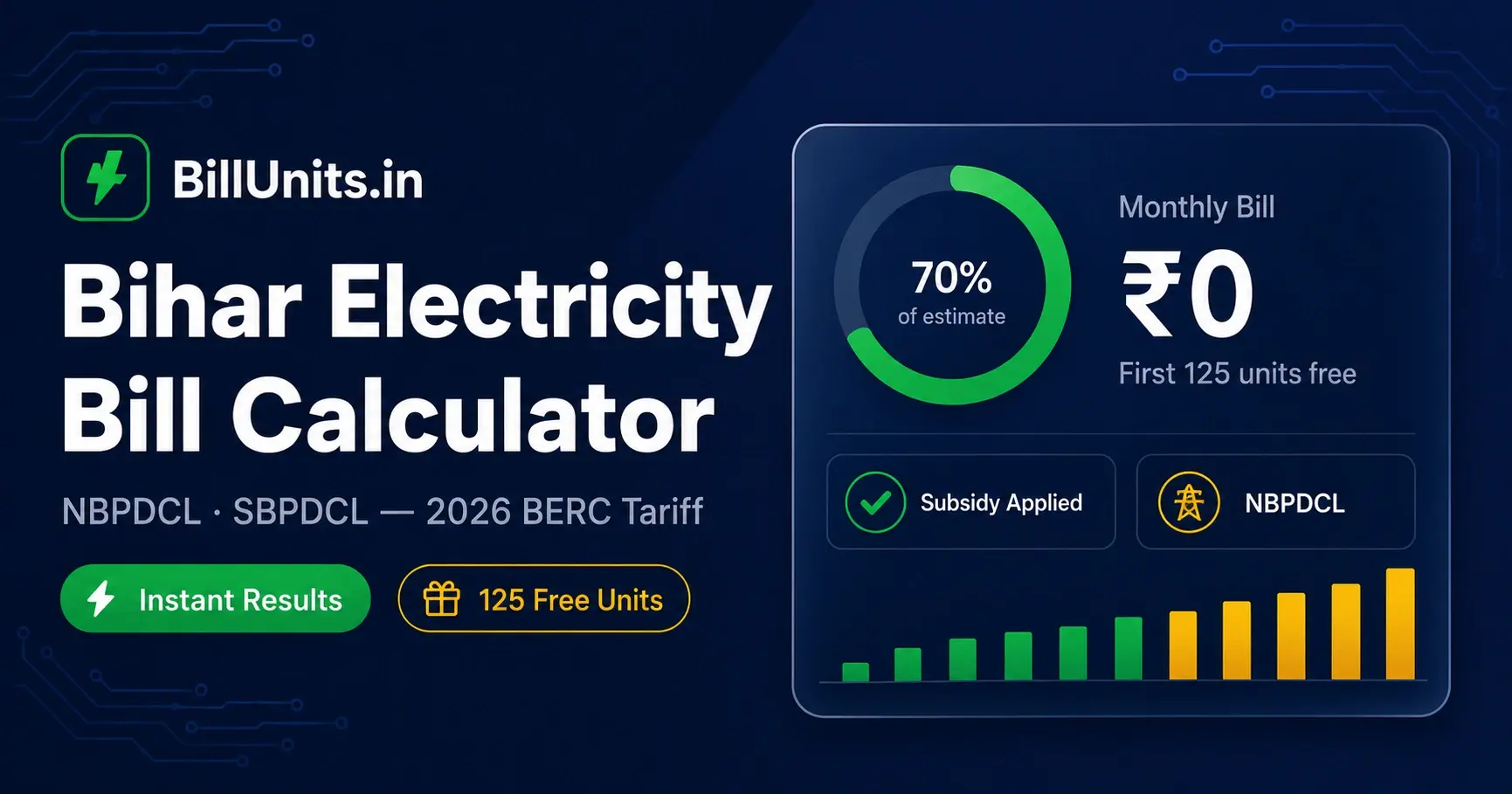
Since 1 August 2025, the Bihar government’s Mukhyamantri Vidyut Upbhokta Sahayata Yojana makes the first 125 units per month free for domestic consumers, covering the energy charge, fixed charge and electricity duty. If your usage is 125 units or less, your payable bill is effectively zero. Above 125 units, the first 125 stay free and you pay only on the units beyond the limit. The benefit is applied automatically through your normal bill.
Bill Calculation Formula
This Bihar electricity bill calculator builds your bill from the energy charge and the fixed charge, then applies the state subsidy on top. The formula it follows is:
Total Bill = (Units × ₹7.42) + Fixed Charge − Subsidy
Where each term is calculated as follows:
- Energy Charges = total units × ₹7.42 (a flat rate applied to every unit).
- Fixed Charge = ₹/kW × your sanctioned load (₹40/kW rural, ₹80/kW urban; ₹20 flat for Kutir Jyoti).
- Subsidy = the first 125 units are free; if usage is 125 units or fewer, the payable bill is ₹0.
The calculator runs this automatically the moment you enter your units and sanctioned load. Electricity duty and FPPCA are set separately by the state and are not included in this estimate; your actual bill may show small additional lines for them.
What Is Included in Your Bihar Electricity Bill
Every Bihar domestic bill (NBPDCL or SBPDCL) is made up of the same line items, and this Bihar electricity bill calculator breaks down each one separately. Understanding each line item helps you read your bill and see why the total changes from month to month:
- Energy charge — the cost of the units you consumed, billed at the flat BERC rate of ₹7.42/unit. This is usually the largest part of the bill.
- Fixed charge — a standing monthly charge based on your sanctioned load in kW (or kVA for larger LT-1 connections), payable even if you use very little electricity.
- State subsidy — Bihar’s 125 free-unit scheme, deducted last, which can bring your payable amount down to zero.
- Other charges on your actual bill — your real bill may also carry electricity duty, a Fuel/Power-Purchase Adjustment (FPPCA) and meter rent. These are set outside the BERC tariff order and are not included in this estimate.
How to Read Your Bihar Electricity Meter
Most homes in Bihar now have either a digital meter or, increasingly, a smart prepaid meter. On a digital meter, note the kWh reading shown on the display — this is the cumulative units consumed. Subtract last month’s reading (printed on your previous bill) from the current reading to get the units used this billing cycle; enter that figure in the calculator.
On a smart prepaid meter, the in-home display or the Bihar Bijli Smart Meter app shows real-time consumption and remaining balance, so you can read units directly without manual subtraction. If your meter cycles through multiple screens, look for the one labelled “kWh” or “Units.”
For NBPDCL and SBPDCL alike, the consumer number on your bill identifies your connection and district; the units figure drives the energy charge, while your sanctioned load (also on the bill) drives the fixed charge.
Sample Bihar Electricity Bills (100 to 400 Units)
- Energy charge = 180 units × ₹7.42 = ₹1,335.60
- Fixed charge = 2 kW × ₹80 = ₹160.00
- Before subsidy ≈ ₹1,496
- After 125 free units = (55 units × ₹7.42) + ₹160 fixed charge ≈ ₹568
A household using 125 units or fewer pays ₹0 — the subsidy covers the energy charge, fixed charge and duty for that band. Above 125 units, only the energy cost of the free block is waived; the fixed charge still applies in full. Confirm against the live calculator above — enter 180 units and a 2 kW load.
| Monthly units | Before subsidy (DS-II, 2 kW) | After 125 free units |
| 100 units | ₹902 | ₹0 (within free limit) |
| 125 units | ₹1,088 | ₹0 (within free limit) |
| 200 units | ₹1,644 | ₹717 (75 units above limit + fixed charge) |
| 300 units | ₹2,386 | ₹1,459 (175 units above limit + fixed charge) |
| 400 units | ₹3,128 | ₹2,201 (275 units above limit + fixed charge) |
Estimates for a DS-II urban connection at ₹7.42/unit (flat) with an ₹80/kW fixed charge on a 2 kW load. The 125 free units cover energy, fixed charge and duty only within that block; above the limit the fixed charge applies in full and you pay the normal rate on the units beyond 125. Excludes any FAC and electricity duty, which are not part of the BERC tariff order. Source: BERC Approved Tariff Order, NBPDCL & SBPDCL, FY 2026-27.
Tips to Reduce Your Bihar Electricity Bill
A few simple habits can keep your usage low and help you make the most of Bihar’s 125 free-unit subsidy:
- Stay under 125 units where you can. If your usage is close to the limit, small cuts can push your payable bill to ₹0, since the first 125 units are free.
- Switch to LED lighting. LED bulbs use up to 80% less power than old incandescent bulbs for the same brightness.
- Use 5-star rated appliances. Star-rated fans, fridges and air-conditioners consume noticeably less over a year.
- Unplug idle devices. Chargers, set-top boxes and TVs on standby quietly draw phantom power around the clock.
- Service your AC and fans. Clean filters and well-maintained motors run more efficiently and cost less to operate.
- Consider rooftop solar. Bihar gets strong sunlight, so even a small rooftop system can offset a large share of your monthly units.
Use the Bihar electricity bill calculator above to test how each of these changes affects your estimated bill, before and after the subsidy.
Common Billing Mistakes in Bihar (And How to Catch Them)
Even with a flat ₹7.42/unit tariff and a single combined BERC order, NBPDCL and SBPDCL bills can still go wrong. Here are the most common mistakes Bihar consumers report, and how to check your own bill against each one.
Wrong Meter Reading
A wrong meter reading is the single most common billing error. It usually happens when a manual reading is misrecorded, a digit is transposed, or an estimated (“average”) bill is issued instead of an actual reading. Compare the “previous reading” and “present reading” printed on your bill against your own meter, or against your last bill’s present reading — they should match exactly. If they don’t, the units billed (and therefore the energy charge) will be wrong.
Duplicate Charge
Duplicate charges can appear when a payment is recorded twice, when an old unpaid amount is carried forward alongside a new bill without being clearly labelled as an arrear, or when a payment made through a third-party app doesn’t sync with NBPDCL/SBPDCL’s own records in time. Check whether any “previous balance” or “arrears” line matches an amount you’ve already paid, and keep your payment receipt or transaction ID until the next bill confirms it.
Wrong Tariff
A wrong tariff category is applied when a connection is billed under the wrong category — for example, a Kutir Jyoti (BPL) household billed at the standard DS-I/DS-II rate, or a domestic connection billed at a commercial rate. Since Bihar’s domestic tariff is flat (₹7.42/unit) rather than slabbed, a tariff mismatch usually shows up as the wrong fixed charge (₹20 flat vs. ₹40/kW vs. ₹80/kW) rather than a wrong energy rate. Check your bill’s category label against the connection type you actually hold.
Late Fee
Missing the due date printed on your bill attracts a late payment surcharge, added on top of your normal bill amount. The exact late-fee rate is not published in the BERC tariff order and can change, so this calculator does not estimate it — check the late-payment surcharge line on your actual bill, or confirm the current rate with NBPDCL/SBPDCL directly, rather than relying on an old bill’s figure.
FAC (Fuel Adjustment Charge)
The Fuel/Power-Purchase Adjustment Charge is a periodic per-unit surcharge set outside the main tariff order, reflecting changes in the cost of fuel and power purchased by the DISCOM. It is reviewed and revised from time to time rather than fixed for the full financial year, which is why this calculator excludes it from its estimate — always check your latest bill for the FAC line currently in effect rather than assuming last month’s rate still applies.
Unexpectedly High Bill
A bill that’s much higher than usual is most often explained by one of: a meter reading error (see above), an estimated bill later corrected with a larger true-up, seasonal usage increase (AC/cooler use in summer), a previously unbilled arrear now added, or — less commonly — a genuine meter fault. Before assuming the bill is wrong, compare this month’s units consumed (not just the rupee amount) against your last 2–3 bills; a real jump in units usually has an explanation, while a jump in rupees with flat or falling units points to a billing error worth disputing.
How to Raise a Complaint
If you spot any of the issues above, NBPDCL and SBPDCL both offer the following channels:
- Toll-free helpline — 1912 or 1800-202-2813, for billing disputes, meter faults, and outage reports.
- Online complaint registration — through the “Grievance” or “Online Complaint Registration” section of the NBPDCL or SBPDCL website, where you select a complaint category (e.g., meter fault, wrong bill), enter your Consumer/CA number, and describe the issue.
- In person — at your nearest NBPDCL or SBPDCL local office, with your last bill and consumer number on hand.
Always note your complaint/ticket number after filing, and keep your bill and payment receipts until the issue is resolved.
Online Bill Payment Guide for NBPDCL & SBPDCL
Once you know your estimated bill from the calculator above, here’s how to actually pay it. NBPDCL and SBPDCL bills can be paid through several official and third-party channels.
Official Website
Visit nbpdcl.co.in or sbpdcl.co.in and use the “Instant Payment” or “View & Pay Bill” option on the homepage. Enter your Consumer Number (also called CA Number or K Number) to fetch your current bill, then choose a payment method to complete the transaction. You can also print or download a payment receipt from the same section after paying.
Mobile App
BSPHCL and NBPDCL offer official apps — Suvidha (BSPHCL’s app, covering both NBPDCL and SBPDCL) and BBBP (Bihar Bijli Bill Pay, NBPDCL’s own app) — for viewing and paying your bill from a phone. Both let you check your bill, make a payment, and view past receipts without visiting the website. Several other general bill-payment apps (such as those from major banks and fintech platforms) also support NBPDCL/SBPDCL as a billing partner, but the official apps are the most direct route to your account.
UPI
UPI is supported as a payment method on the official NBPDCL/SBPDCL payment pages and through BBPS-enabled UPI apps. Enter your Consumer Number, confirm the bill amount, and approve the payment in your UPI app (Google Pay, PhonePe, Paytm, BHIM, or your bank’s own UPI app) using your UPI PIN.
Net Banking
Net banking is available as a payment option on the official payment pages and most third-party billers. After fetching your bill, select net banking, choose your bank from the list, and complete the payment by logging into your bank’s net banking portal.
Credit Card
Credit card payments are accepted on the official sites and through BBPS-enabled platforms. Note that some third-party platforms add a convenience fee for card payments (commonly up to around 2% of the bill amount, varying by platform) — paying directly on the NBPDCL/SBPDCL website typically avoids this.
Debit Card
Debit cards work the same way as credit cards for bill payment — select the option, enter your card details, and authenticate with your bank’s OTP. As with credit cards, paying through a third-party app may carry a small convenience fee that direct payment on the official site usually avoids.
BBPS (Bharat Bill Payment System)
NBPDCL and SBPDCL are both onboarded as billers on BBPS, the RBI-backed interoperable bill payment network. This means you can pay your Bihar electricity bill through any BBPS-enabled app or platform — including most major banking apps, UPI apps, and fintech bill-pay platforms — by simply searching for “NBPDCL” or “SBPDCL” as the biller and entering your Consumer Number. BBPS payments are standardised and give you a uniform payment confirmation regardless of which app you use.
Before paying anywhere: double-check your Consumer/CA number against your latest bill, since an incorrect number can fetch the wrong account’s bill. Keep your payment confirmation or transaction ID until your next bill confirms the payment was received.
About NBPDCL & SBPDCL
| Regulator | Bihar Electricity Regulatory Commission (BERC) |
| North Bihar DISCOM | NBPDCL official site |
| South Bihar DISCOM | SBPDCL official site |
| Pay your bill | NBPDCL / SBPDCL portals, or the Bihar Bijli app |
Districts Covered by NBPDCL and SBPDCL
NBPDCL (North Bihar): Muzaffarpur, Darbhanga, Sitamarhi, Madhubani, East & West Champaran, Sheohar, Supaul, Saharsa, Madhepura, Araria, Kishanganj, Purnia, Katihar and Bhagalpur.
SBPDCL (South Bihar): Patna, Gaya, Nalanda, Bhojpur, Buxar, Rohtas, Kaimur, Aurangabad, Arwal, Jehanabad, Nawada, Jamui, Lakhisarai, Sheikhpura and Munger.
Both companies are subsidiaries of the Bihar State Power (Holding) Company Limited (BSPHCL) and bill under one common BERC tariff, so this Bihar electricity bill calculator gives the same result across all Bihar districts — only the billing entity differs.
Frequently Asked Questions
Q1. Does Bihar give free electricity?
Ans: Yes. Since 1 August 2025, domestic consumers get the first 125 units each month free under the Mukhyamantri Vidyut Upbhokta Sahayata Yojana, covering energy charge, fixed charge and electricity duty. Below 125 units your bill is zero; above it you pay only on the extra units.
Q2. Is the calculator the same for NBPDCL and SBPDCL?
Ans: Yes. BERC issues one combined tariff order for both companies, so domestic rates are identical across North and South Bihar. Only the billing company differs, based on your district.
Q3. Does Bihar charge electricity in slabs?
Ans: No. For FY 2026-27, BERC approved a single flat energy rate of ₹7.42/unit for all domestic units (Kutir Jyoti, DS-I rural and DS-II urban) – there are no telescopic slabs. Only the fixed charge differs, by category and sanctioned load. The optional DS-III category is a flat ₹9.03/unit. The 125 free-unit state subsidy then applies on top.
Q4. Why might my actual bill differ from this estimate?
Ans: Bills vary with electricity duty, FPPCA, meter rent, the above-limit subsidised treatment, past arrears, prorated billing days, and rounding. Treat this as a close planning estimate, not an exact bill.
Q5. How many units of electricity are free in Bihar?
Ans: The first 125 units per month are free for domestic consumers under the Mukhyamantri Vidyut Upbhokta Sahayata Yojana, effective from 1 August 2025. The free allowance covers the energy charge, fixed charge and electricity duty for those units.
Q6. What is the fixed charge on a Bihar electricity bill?
Ans: The fixed charge is a standing monthly amount based on your sanctioned load – ₹40/kW for DS-I rural and ₹80/kW for DS-II urban, or a flat ₹20/connection for Kutir Jyoti. It is payable regardless of how many units you consume.
Q7. How is electricity duty calculated in Bihar?
Ans: Electricity duty in Bihar is a state levy under the Bihar Electricity Duty Act, set separately from the BERC tariff order. Because it isn’t part of the published tariff and can change, this calculator does not add it – check your actual bill for any duty applied.
Q8. What is the Fuel Adjustment Charge (FAC)?
Ans: FAC (Fuel and Power Purchase Adjustment) is a periodic per-unit adjustment set outside the main tariff order. It isn’t included in this estimate, though your actual bill may show a small FAC line. Refer to your latest bill for the current value.
Q9. What is the difference between NBPDCL and SBPDCL?
Ans: NBPDCL supplies North Bihar districts and SBPDCL supplies South Bihar, including Patna. Both follow the same BERC tariff, so your bill is calculated identically – only the billing company differs by district.
Q10. How can I pay my NBPDCL or SBPDCL bill online?
Ans: You can pay through the official NBPDCL or SBPDCL portals, the Bihar Bijli Bill Pay app, or common payment apps using your consumer number. Always verify the consumer number printed on your bill before paying.
Q11. Does Bihar use smart prepaid meters?
Ans: Yes. Bihar has rolled out smart prepaid meters widely. With a prepaid meter you recharge in advance and consumption is deducted from your balance; the in-home display or app shows real-time units and remaining balance.
Q12. How accurate is this Bihar electricity bill calculator?
Ans: The Bihar electricity bill calculator uses BERC-approved FY2026-27 energy and fixed charges, and applies the 125 free-unit subsidy, so it gives a close planning estimate. Your actual bill can still differ slightly due to electricity duty, FAC, meter rent, arrears, prorated billing days and rounding.
Q13. Is BSEB the same as NBPDCL and SBPDCL?Q13. Is BSEB the same as NBPDCL and SBPDCL?
Ans: “BSEB” (Bihar State Electricity Board) is the older name people still use for Bihar’s power utility. It was unbundled into NBPDCL and SBPDCL under the holding company BSPHCL. So a BSEB bill calculator and an NBPDCL/SBPDCL calculator are the same thing – both use the BERC tariff.
Q14. What sanctioned load should I enter?
Ans: Enter the load printed on your bill or connection agreement, usually in kW (for example 1 kW, 2 kW or 3 kW). The fixed charge is billed per kW of this sanctioned load, so a higher load means a higher monthly fixed charge regardless of units used.
Written and reviewed by Amal Mog. Rates are cross-checked against the official BERC FY2026-27 tariff order for NBPDCL & SBPDCL. Last verified: June 2026. See
About the Author · Methodology · Data Sources · Editorial Policy